Metal Hardness in Architectural Restoration: The Short Answer
Hardness is how well a metal resists scratching, denting, and abrasion, and it decides how that metal can be cleaned and repaired. Soft metals such as lead, zinc, and sheet copper are abraded by methods that suit cast iron. Bronze needs gentler treatment than its hardness suggests. Match the method to the metal, or the cleaning does more harm than the corrosion.
TLDR:
- Hardness is resistance to scratching, denting, and abrasion. Brittleness is a separate trait.
- Lead, zinc, sheet copper, and plated metals are soft or thin. The National Park Service prefers chemical or thermal cleaning for them.
- Cast iron is hard and brittle. Low-pressure grit blasting is often the most effective way to clean it.
- Bronze is harder than copper, yet sandblasting is particularly damaging to it.
- Never use a wire brush or steel wool on a nonferrous metal.
- Replacement copper should match the original weight, configuration, and temper or hardness.
A single New York facade can carry lead flashing, copper roofing, bronze doors, and cast iron columns. In 2026 the Landmarks Preservation Commission counts more than 38,000 landmark properties in the five boroughs, and owners of those buildings often ask one question first: what can this metal take?
Not sure what metal you have?
Send us photographs of the piece and a note on what is wrong. We will tell you what the metal is, what it can safely take, and what the work involves.
What Hardness Means, and What It Does Not
Hardness is easy to confuse with strength and toughness. They are different properties, and restoration decisions depend on the differences.
Labs measure hardness with standard indentation tests. ASTM publishes methods for the Rockwell scale, the Brinell scale, and the Vickers and Knoop scales. The National Institute of Standards and Technology supplies reference materials for calibrating Rockwell, Vickers, and Knoop testers.
On a historic building, nobody cuts a coupon to test a balustrade. We identify the metal, read its condition, and apply what is known about how that metal behaves.
Hardness also does not mean toughness. The National Park Service’s Metals in America’s Historic Buildings, revised in 1992, says cast iron is too hard and brittle to be shaped by hammering, rolling, or pressing. It is weak in tension and fails under tensile load with little prior warning.
Lead sits at the other end. The same publication describes lead as so soft that a fingernail can scratch it. The next sections take the metals in order of how easily they are damaged.
Soft Metals: Lead, Zinc, Tin, and Sheet Copper
Soft metals lose their surface to methods that barely mark iron. On a building, that surface is often the finish, the detail, and the weather protection.
The NPS guide says lead and copper are subject to damage by erosion and abrasion, and that zinc is softer than iron. It also notes that tin is soft enough that it is rarely used by itself. Tin’s main architectural uses are as an alloying element with copper to make bronze and as a coating on harder metals such as tinplated iron or steel, according to the guide’s historical survey of metals.
For cleaning, the guide is direct. Most metals other than iron, bronze, and some brasses generally should not be cleaned mechanically, because they are soft or thin and would be deformed or abraded. It prefers a chemical or thermal method for lead, zinc, sheet copper, and plated metals such as tinplate, terneplate, chromeplate, and galvanized steel.
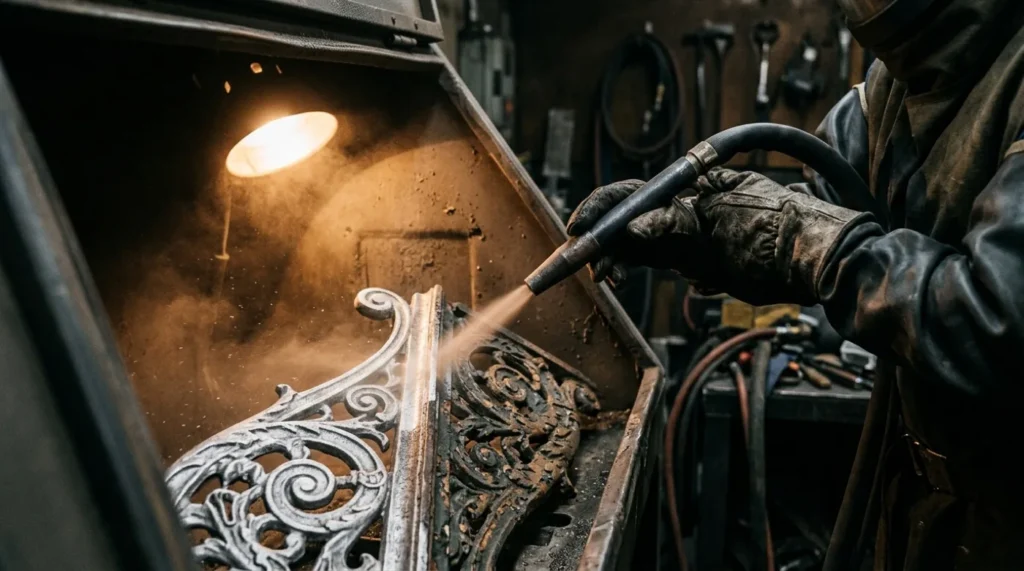
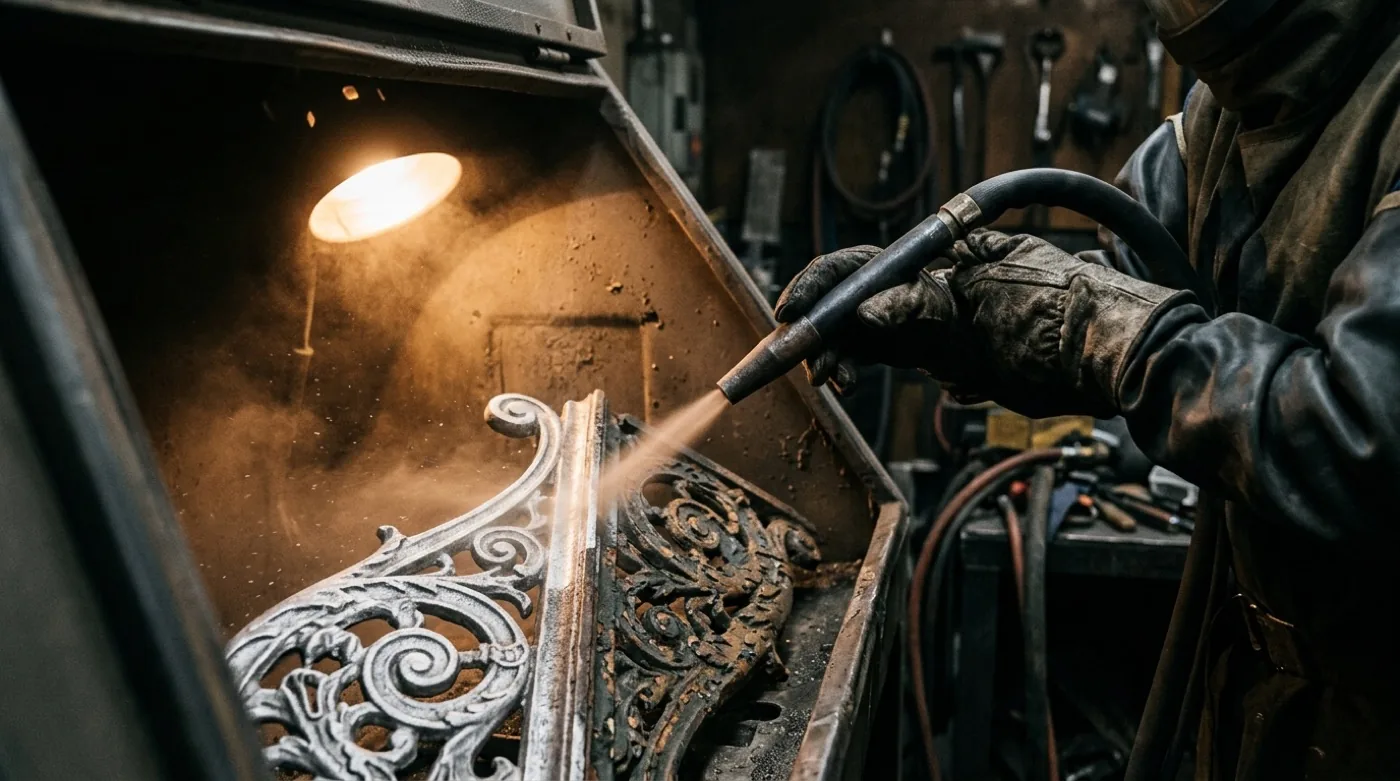
The shop practice follows the same logic. Our blasting work in Mount Vernon starts with the media, not the machine. Sand is aggressive and suits heavy steel and iron. It is the wrong choice for thin sheet, soft metals, and fine castings, so we use soda, glass, or plastic media on those.
One mistake is common enough to name. The NPS guide warns against using a wire brush or steel wool on nonferrous metals, since it can cause galvanic corrosion or abrade the softer metal.
Bronze and Brass: Harder Than You Would Guess, Easier to Ruin
Bronze and brass are harder than copper, which tempts people to treat them like iron. That is where the damage starts.
The NPS historical survey notes that early civilizations preferred bronze to iron for its hardness. It adds that aluminum or iron in the bronze mixture makes a harder substance. It calls brass a hard, durable metal, and it describes beta brasses as having comparatively high tensile strength and hardness.
Hardness is not the same as tolerance for abrasion. The NPS guide says sandblasting, a common method for cleaning cast iron, is particularly damaging to bronze surfaces. Glass bead peening, common in the 1970s, has fallen out of favor. It also says cleaning down to bright metal, by any means, is often inappropriate.
The guide describes gentler options: washing with deionized water and a non-ionic detergent, chemical cleaning, and low-pressure blasting with soft media such as crushed walnut shells. It treats the patina as protection to be kept if possible.
Our principle on bronze is the least aggressive method that does the job. That applies to work like the bronze gates at the Alexander Hamilton US Custom House. Our guide to how bronze, brass, and copper restore differently covers the finish choices in detail.
Bronze or brass that needs more than a wipe-down?
We clean, refinish, and protect bronze and brass entrances, railings, and hardware for the metal and its existing finish. Tell us what you have and we will tell you what we would do.
Cast Iron and Wrought Iron: Two Irons, Two Behaviors
Iron comes in two forms that behave differently, and the harder one is the more forgiving to clean.
Per the NPS guide, cast iron is an alloy with a high carbon content, at least 1.7 percent and usually 3.0 to 3.7 percent. The flakes of free graphite account for its brittleness. Wrought iron is almost pure iron and is relatively soft, malleable, and tough, so it can be forged, bent, and drawn.
That difference shows up in the work. For large, very hard components such as cast iron, the guide says dry grit blasting may be preferable because it is more thorough and more economical. In its chapter on iron, it calls low-pressure grit blasting often the most effective way to remove heavy paint or corrosion, and cautions against very sharp aggregate or excessive pressure.
Wet blasting is the exception. The guide says it is generally not considered an effective technique on cast iron, because the water causes instant surface rusting and penetrates open joints.
At Yale’s Harkness Tower we stripped 27 cast iron windows in a chemical bath and bead blasted them to sound metal. Cast iron is the metal that tolerates that kind of treatment.
Matching the Cleaning Method to the Metal
The pattern across all of these metals is that the method follows the metal. This table collects what the National Park Service guidance says for each group.
| Metal | How the NPS guide describes it | Cleaning approach the guide favors |
|---|---|---|
| Lead and zinc | Lead is so soft a fingernail scratches it. Zinc is softer than iron. | Chemical or thermal methods, not mechanical |
| Sheet copper and plated metals | Soft or thin, finish easily abraded | Chemical or thermal methods |
| Bronze and some brasses | Harder than copper. Sandblasting is particularly damaging to bronze | Gentle washing, chemical cleaning, or low-pressure soft media. Not sandblasting |
| Cast iron | Very hard, brittle, weak in tension | Low-pressure grit blasting is often the most effective. Wet blasting is generally not |
| Wrought iron | Relatively soft, malleable, tough | Blasting is possible, with care for the surrounding materials |
Read the table as a decision aid, not a recipe. Condition, coatings, and what sits next to the metal all change the answer, which is why we assess a piece before we quote it.
The same logic carries past cleaning, into polishing, plating, and replacement.
How Hardness Shapes Polishing, Plating, and Replacement
Hardness does not stop mattering once the metal is clean. It sets how much surface a polisher can remove, which finishes hold up, and what a replacement part must match.
On polishing, metal removed is metal you do not get back. On antiques and architectural hardware, our hand polishing work takes the least aggressive route that will do the job. Scratches usually come out, while deep pitting is limited by how much material can safely be removed.
On plating, the NPS historical survey calls nickel a hard, silvery-white metal. Our guide to brass, chrome, nickel, copper, and gold plating compares how each finish behaves.
On replacement, the NPS guide gives a clear rule for copper. When a damaged element cannot be salvaged, replace it with new copper of the same weight, configuration, and temper or hardness. It also warns that an element can fail from using the wrong temper or gauge of copper.
If you are not sure what an existing element is made of, our guide to identifying original metal on a historic building walks through the checks. For the full scope of work, see how architectural metal restoration is planned and priced.
Common Questions About Metal Hardness in Architectural Restoration
These are the questions owners, architects, and property managers ask when they are deciding how to clean or repair metal on an older building.
What is metal hardness?
Hardness is a metal’s resistance to scratching, denting, and abrasion. Labs measure it with indentation tests such as Rockwell, Brinell, and Vickers. It is not the same as toughness. Cast iron is very hard but brittle, while wrought iron is softer, malleable, and tough.
Is harder metal always easier to clean?
No. Hardness only tells you how well a metal resists marking. Bronze is harder than copper, yet the National Park Service says sandblasting is particularly damaging to it. Cast iron tolerates low-pressure grit blasting, but wet blasting is generally not effective on it.
Why can sandblasting damage soft metals?
Abrasive blasting removes surface material. Soft or thin metals such as lead, zinc, and sheet copper are deformed or have their finish abraded by it. The National Park Service prefers chemical or thermal cleaning for them. We match media to the metal, using soda, glass, or plastic media on soft work.
Can I use steel wool or a wire brush on brass or bronze?
Avoid it. The National Park Service warns against using a wire brush or steel wool on nonferrous metals, since it can cause galvanic corrosion or abrade the softer metal. Clean brass and bronze with methods suited to the metal and its existing finish, and leave protective patina in place where possible.
How do I know which metal I have?
Often you cannot tell from a photograph, because paint, tarnish, and old coatings hide the surface. Identification starts with the building’s records and a close look at the metal itself. Send us photos and a description, and we will tell you what we think it is and what it can safely take.
Have metal that needs the right method?
Send us photos and a note on what you are seeing. We will tell you what the metal is and what we would use, working on site and in our Mount Vernon shop across NYC and the tri-state area.