
Restoring the Bronze Gates at the Alexander Hamilton U.S. Custom House
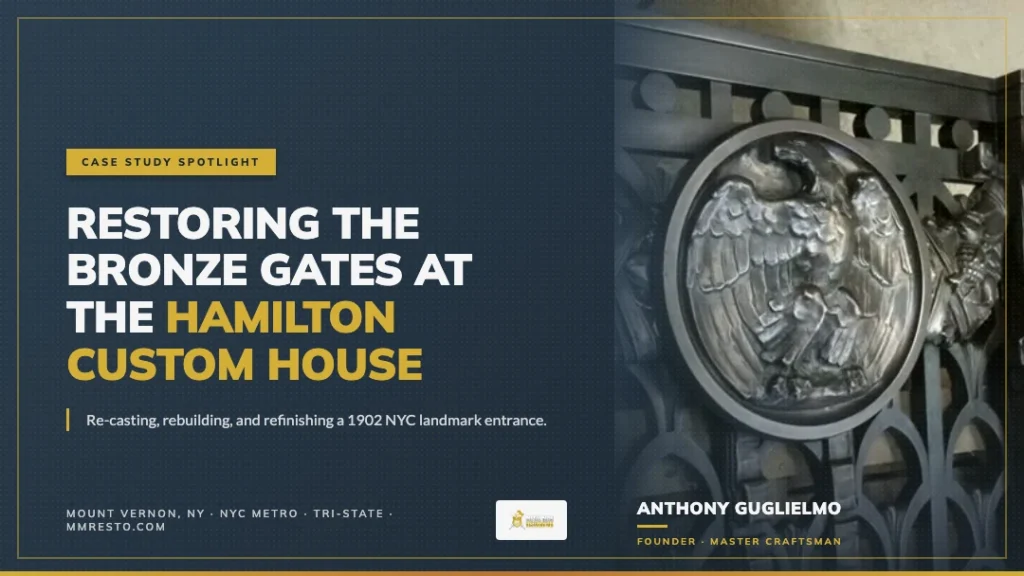
In August 2009, the U.S. Government hired my team at Metal Man Restoration to restore the exterior bronze gates at the front entrance of the Alexander Hamilton U.S. Custom House in New York City. Dating to the building’s completion in 1902, the gates no longer worked and the finish was buried under old paint and grime. Here is how we brought them back to full use.
The short version
- The project: the exterior bronze gates at the front entrance of the Alexander Hamilton U.S. Custom House in NYC, dating to the building’s completion in 1902.
- Hired by the U.S. Government in August 2009.
- Condition: the gates no longer operated, the bronze caster wheels would not turn, one gate was missing a large bronze finial section, and the finish was hidden under paint, dirt, and grime.
- We re-cast the missing finial and fabricated it back into the gate, made welding repairs, and rebuilt the bronze caster wheels so the gates swung freely again.
- We recreated the original statuary bronze finish, the chemically applied patina that gives the metal its authentic tone.
- The work took several months and returned the gates to full use at the Custom House entrance.
A working gate is more than a finish. At the Alexander Hamilton U.S. Custom House, the bronze gates are a defining feature of the entranceway, and they had stopped doing the one thing a gate is supposed to do. Bringing them back meant solving the mechanical problems and the cosmetic ones together, because on a piece like this neither one counts without the other.
What We Restored
The assignment was the pair of exterior bronze gates at the building’s front entrance. They date to the Custom House’s completion in 1902 and are original to the entranceway. After more than a century of use and weather, they needed both structural repair and a full refinish to return to service.
The Condition: A Grand Gate That No Longer Worked
The gates arrived at our facility in poor condition. They no longer operated correctly, and the bronze caster wheels that carry their weight would not turn properly. One gate was missing a large bronze finial section entirely. On top of the mechanical trouble, the finish was buried under old paint, dirt, and grime that hid the bronze underneath.
How We Restored the Gates
Over several months, we rebuilt the gates from the structure out. We re-cast the missing finial section and fabricated it back into the gate so the pair matched again, then made the welding repairs the bronze required. We rebuilt the bronze caster wheels so the gates would swing freely the way they were designed to.
With the mechanics sound, we turned to the finish. We recreated the original statuary bronze finish, the chemically applied patina that gives the metal its authentic tone, rather than painting on a color that would chip and fade. The result preserved the gates’ historic value and returned them to full, working use at the entrance.
Why Re-Casting Beats Replacing
When a historic gate is missing a finial or a casting, the temptation is to buy a substitute that is close enough. On a 1902 landmark, close enough is wrong. Re-casting the missing section to match the original keeps the gate true to its design and its date, so the repair disappears into the whole instead of standing out as a patch.
What This Means for Owners of Historic Entrances
If you manage a building with original bronze gates, doors, or hardware that have stopped working, the Custom House project shows the path. Seized casters, missing castings, and a paint-buried finish are all repairable, and repair almost always beats replacement on a landmark entrance. The key is treating the metalwork and the mechanism as one job. For the broader approach, see our architectural metal maintenance guide for property managers.
Common Questions About Restoring Historic Bronze Gates and Hardware
These are the questions building owners and preservation teams ask us most about bronze gates, doors, and operating hardware.
Can a bronze gate that no longer opens be restored?
Yes. At the Custom House, the gates would not operate and the caster wheels would not turn, and we rebuilt them to swing freely again. Seized or worn operating hardware can be rebuilt or re-cast in bronze, so a gate that has been propped open for years can return to daily use.
Can a missing finial or casting be replaced?
Yes, by re-casting it to match the original. One Custom House gate was missing a large bronze finial section, which we re-cast and fabricated back in. Matching the original casting keeps a historic gate authentic rather than leaving an obvious modern patch.
What is a statuary bronze finish?
It is a patina developed chemically into the bronze to produce a deep, authentic tone. It is not paint. Because the color lives in the metal, it looks correct on a historic piece and ages gracefully instead of chipping, which is why we recreated it on the Custom House gates.
How long does a bronze gate restoration take?
It depends on the structural work involved. The Custom House gates took several months because they needed re-casting, welding, and a full caster rebuild on top of refinishing. A gate that only needs cleaning and a new finish moves much faster. We give a realistic timeline after inspecting the piece.
How do I start a gate or hardware restoration project?
Send us photos of the gate or hardware, the building location, and a note on what is failing, a seized hinge, a missing casting, or a paint-buried finish. We will tell you honestly if it is a candidate for restoration and what the work would involve. You can reach us through our contact page.
Have historic gates, doors, or hardware that need expert hands?
We restore architectural bronze, operating hardware, and ornamental metal for government, institutional, and private buildings across the New York metro and the tri-state area.
More from our shop:
- Alexander Hamilton U.S. Custom House case study. The full bronze gate restoration project.
- Architectural metal restoration for building owners and architects. The overview guide for property decision-makers.
- Award-winning bronze restoration at Newark City Hall. A spotlight on our Newark City Hall project.