Restoring the Babe Ruth and Lou Gehrig Plaques
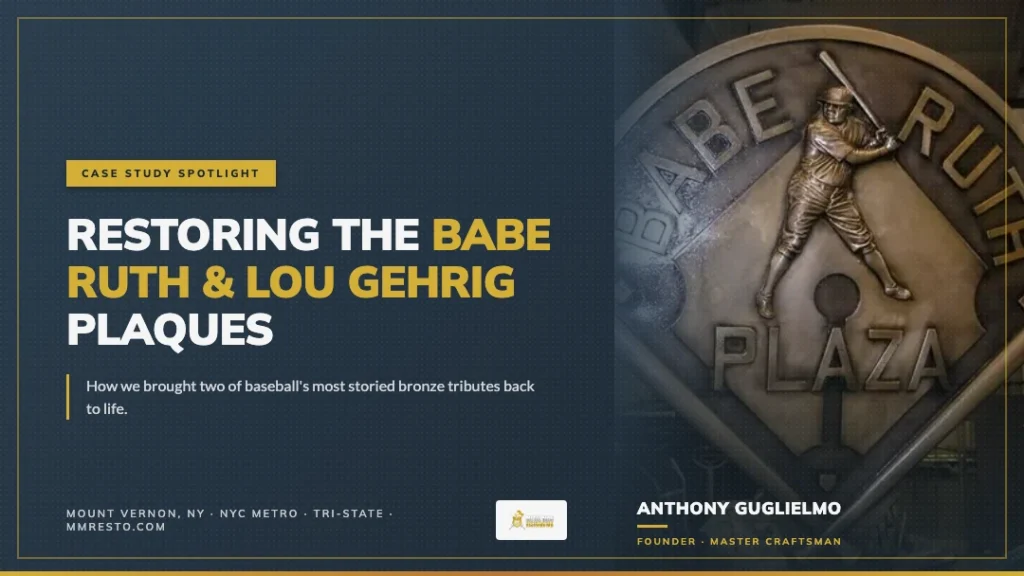
In April 2008, the New York Yankees and Skanska Construction Corporation hired my team at Metal Man Restoration to restore two of baseball’s most storied tributes: the bronze plaques honoring Babe Ruth and Lou Gehrig. Cast in the 1940s, they were so caked in old paint and grime that they were first mistaken for cast iron. Here is how we brought them back.
The short version
- The project: the Babe Ruth Plaza and Lou Gehrig Plaza plaques, cast in the mid-to-late 1940s to honor the two Yankee legends.
- Hired in April 2008 by the New York Yankees and Skanska Construction Corporation.
- The plaques were so buried under paint, dirt, and grime they were first mistaken for cast iron. Solid bronze sat underneath.
- We stripped the buildup without abrading the metal, made welding repairs, replaced hardware with original-style brass, and refinished to a statuary bronze.
- The plaques were sealed with a protective polyurethane clear coat to hold the finish.
- The work recovered the crisp lettering and relief that make a commemorative plaque worth keeping.
Some projects carry more history than metal. The plaques honoring Babe Ruth and Lou Gehrig are exactly that, public tributes to two of the most famous names in American sport. When the Yankees and Skanska brought them to us, the job was not just to clean bronze. It was to recover a piece of the city’s memory without leaving a mark of our own on it.
What We Restored
The work covered the Babe Ruth Plaza and Lou Gehrig Plaza plaques, cast in the mid-to-late 1940s to honor the Yankee legends and displayed at the Bronx County Courthouse and Babe Ruth Plaza. After decades on public display, both needed conservation to recover their original finish and the fine detail of the castings.
The Condition: Mistaken for Cast Iron
When the plaques reached our shop, they were so caked in old paint, dirt, and grime that they were first taken for cast iron. A closer look showed solid bronze beneath the buildup. That kind of obscuring layer is common with older outdoor bronze. Airborne pollutants, well-meaning coats of paint, and ordinary weathering dull the surface and flatten the crisp lettering and relief.
How We Restored the Plaques
The work moved in stages, the same disciplined sequence we follow on historic bronze of any scale. First we carefully stripped away the old paint, grime, and failed coatings without abrading the underlying metal or the cast detail. On a commemorative plaque, the detail is the whole point, so nothing aggressive touches the surface.
With the bronze exposed, we completed the repairs the plaques needed: welding where the metal called for it and replacing hardware with original-style brass. Then we recreated the original statuary bronze finish and sealed each plaque with a protective polyurethane clear coat, so the finish would hold up to another long run outdoors.
Why the Lettering and Relief Matter
A commemorative plaque lives or dies on its lettering and relief. Those are the parts that carry the names, the dates, and the likeness, and they are the first things lost when grime builds up or a careless cleaning grinds them down. Recovering that detail, rather than just shining the surface, is what separates conservation from a quick polish.
What This Means for Owners of Public Monuments and Plaques
If you are responsible for a public plaque, monument, or memorial, the Yankee plaques are a useful lesson. A bronze that looks like rusted iron is usually sound underneath, and aggressive cleaning does more harm than the grime. The right approach is careful stripping, real repair where needed, an authentic statuary finish, and a protective coat to slow the next round of weathering. For the broader playbook, see our architectural metal maintenance guide for property managers.
Common Questions About Restoring Historic Bronze Plaques
These are the questions we hear most from cities, institutions, and property owners weighing a plaque or monument restoration.
Why did the bronze plaques look like cast iron?
Years of paint, dirt, and grime built up into a dark, dull crust that hid the bronze. It happens often with older outdoor plaques. Pollutants, past coats of paint, and weathering obscure the metal so thoroughly that the bronze underneath is easy to miss until you start cleaning.
Can you restore a bronze plaque without losing the lettering?
Yes, and protecting the lettering is the priority. The buildup is stripped carefully so the cast detail is never abraded. Aggressive grinding or harsh blasting can flatten the relief permanently, so the surface is treated with methods that lift grime without cutting into the metal.
Should outdoor bronze plaques be sealed?
Yes. After refinishing, a protective clear coat such as polyurethane slows re-oxidation and helps the finish survive sun, rain, and pollution. The Yankee plaques were sealed this way. A periodic maintenance check keeps the coating sound and extends the time between full restorations.
Can damaged or corroded plaques be repaired?
Usually, yes. Cracks and worn spots can be welded, and missing or failed hardware can be replaced with original-style brass. Repair preserves the original casting, which matters most on a piece whose value is historical rather than just material.
How do I start a plaque or monument restoration?
Send us photos of the piece, its location, and a note on what you are seeing, paint buildup, corrosion, or damage. We will tell you honestly if it is a candidate for restoration and what the work would involve. You can reach us through our contact page.
Have a plaque, monument, or memorial that needs expert care?
We restore commemorative bronze, architectural metal, and ornamental work for cities, institutions, and building owners across the New York metro and the tri-state area.
More from our shop:
- Yankee Stadium plaques case study. Restoring the Babe Ruth and Lou Gehrig plaques.
- Architectural metal restoration for building owners and architects. The overview guide for property decision-makers.
- Award-winning bronze restoration at Newark City Hall. A spotlight on our Newark City Hall project.