Restoring the Award-Winning Bronze at Newark City Hall
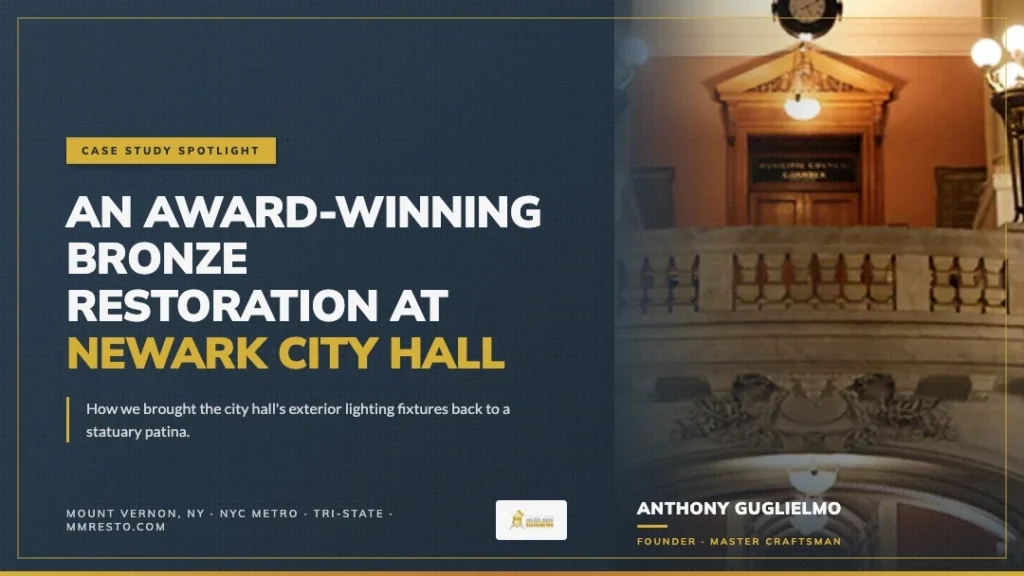
In 2006, my team at Metal Man Restoration restored the exterior bronze lighting fixtures and window hardware at Newark City Hall: two large front-entrance fixtures, six smaller side-entrance fixtures, and the surrounding hardware. The work earned the New Jersey Historical Restoration Award for the Exterior Restoration of Newark City Hall. Here is how we brought century-old bronze back to life.
The short version
- The project covered the exterior bronze lighting fixtures and window hardware at Newark City Hall, a Beaux-Arts civic landmark in New Jersey.
- Scope: two large front-entrance fixtures, six smaller side-entrance fixtures, and the window hardware throughout.
- The bronze had gone tarnished and overpainted, hiding the original detail.
- We stripped the fixtures, glass-bead blasted them back to clean bronze, then oxidized them to a statuary patina with select areas left in a bright satin finish.
- The job earned the New Jersey Historical Restoration Award for the Exterior Restoration of Newark City Hall.
- Done right, bronze restoration protects a building’s historic character and avoids the cost of replacement.
Newark City Hall is one of New Jersey’s most recognizable civic buildings, a Beaux-Arts landmark whose bronze details have greeted the public for more than a century. When original bronze like that starts to disappear under tarnish and old paint, the building loses something that cannot be bought off a shelf. That is the kind of work we live for.
What the Newark City Hall Project Involved
The assignment was the building’s exterior bronze: two large lighting fixtures at the front entrance, six smaller fixtures at the side entrances, and the bronze window hardware throughout. These pieces take the full force of the weather year round, and they are the first thing a visitor sees up close. We brought the fixtures into our Mount Vernon facility so each one could get the attention it needed off-site, then returned them ready to reinstall.
The Condition: Decades Under Paint and Tarnish
By the time we received the fixtures, years of weather and well-meaning coats of paint had buried the bronze. The surfaces were tarnished and grimy, and the crisp cast detail that gives architectural bronze its character was flattened under buildup. None of that means the metal is gone. Underneath, the bronze was sound, which is almost always the case with quality historic castings. The job was to remove what did not belong and bring the original surface back.
How We Restored the Bronze
Every fixture moved through the same disciplined sequence. First we stripped away the old paint and grime without harming the metal or the cast detail beneath it. Then we glass-bead blasted each piece to bring the surface back to clean, even bronze. Bead blasting is gentle enough to preserve fine detail while removing what hand-cleaning never could.
With the bronze clean, we rebuilt the finish. Most of each fixture was oxidized to a statuary patina, a finish applied chemically rather than painted on, so the tone looks authentic and ages gracefully. On select areas we left a bright satin bronze for contrast, the way the fixtures were meant to read. Finally, every fixture was returned to working order so it could go back into daily service at the building.
Why the Statuary Patina Matters
A statuary finish is not paint, and that distinction is the whole game on a historic building. Paint sits on top of the metal, chips, and looks wrong within a season. A statuary patina is chemically developed into the bronze itself, so it carries the depth and warmth the original craftsmen intended and wears in instead of wearing off. For a landmark like Newark City Hall, that authenticity is exactly what a preservation review is looking for.
Recognition: A New Jersey Historical Restoration Award
The Newark City Hall work received the New Jersey Historical Restoration Award for the Exterior Restoration of Newark City Hall. An award is nice, but what it really confirms is that the result met the standard preservation professionals hold for landmark metal. That is the bar we bring to every fixture and door that comes through the shop, award or no award.
What This Means for Property Managers and Building Owners
If you manage a building with original bronze, brass, or copper, the Newark project is a useful model. Tarnished, painted, tired-looking metal is rarely beyond saving. When the underlying castings are sound, restoration costs a fraction of replacement and keeps the building’s history intact. The key is acting before corrosion goes deep, and using methods that protect the metal instead of grinding it away. For a wider playbook, see our architectural metal maintenance guide for property managers.
Common Questions About Historic Bronze Restoration
These are the questions building owners and managers ask us most when they are weighing a project like Newark City Hall.
Can tarnished, painted bronze really be restored?
In most cases, yes. When the underlying bronze is sound, stripping the paint and grime, cleaning the surface, and rebuilding the finish brings it back. At Newark City Hall, fixtures that looked beyond hope were returned to a full statuary patina. Deep corrosion or missing parts may call for repair or fabrication first.
What is a statuary bronze finish?
A statuary finish is a patina developed chemically into the bronze to produce a deep, even tone. It is not paint. Because the color lives in the metal, it looks authentic and ages gracefully rather than chipping, which is why it is the right choice for historic fixtures.
Is restoring bronze cheaper than replacing it?
Usually, yes, and especially for historic or custom castings that would be expensive to reproduce. When the metal is structurally sound, restoration preserves the original piece at a fraction of replacement cost while keeping the building’s character. Replacement makes sense mainly when damage is severe or parts are missing.
Do you restore fixtures on-site or in your shop?
It depends on the piece. For Newark City Hall, the lighting fixtures and hardware came to our Mount Vernon facility for stripping, blasting, and refinishing, then went back for reinstallation. Larger doors and architectural elements are often restored in place. We match the approach to the project.
How do I start a historic metal restoration project?
Send us photos of the metal, the building location, and a note on what you are seeing, tarnish, paint, corrosion, or damaged parts. We will tell you honestly if it is a candidate for restoration and what the work would involve. You can reach us through our contact page.
Projects like this follow a fixed order. We broke down how a landmark metal project runs from approval to scaffold for owners planning similar work.
Have historic metal that needs expert hands?
We restore architectural bronze, brass, copper, and more for building owners, property managers, and preservation teams across the New York metro and the tri-state area.
More from our shop:
- Newark City Hall case study. The award-winning bronze restoration in full.
- Architectural metal restoration for building owners and architects. The overview guide for property decision-makers.
- Lighting restoration. How we approach chandelier and architectural lighting work.