

Chandelier and Architectural Lighting Restoration Across New York City
Quick answer: Restoring an antique chandelier or architectural light fixture means fully disassembling it, cleaning and polishing or re-plating the metal, protecting it with fresh lacquer, and rewiring it with new sockets and UL-listed parts to meet the NYC Electrical Code. For a designated landmark lobby or interior, the work can also require a Landmarks Preservation Commission permit before it starts.
TLDR:
- A real restoration is part metal finishing and part electrical work, not just a cleaning.
- The process runs document, disassemble, clean, strip old lacquer, polish or re-plate, re-lacquer, rewire, and reinstall.
- Antique fixtures should be rewired with new sockets and UL-listed components to meet the NYC Electrical Code.
- Old cloth-insulated wiring turns brittle and becomes a real shock and fire hazard.
- Fresh lacquer seals polished brass and bronze, so the finish holds for years instead of tarnishing in months.
- Work on a designated landmark interior or lobby can require a permit from the NYC Landmarks Preservation Commission.
- Cost depends on the fixture’s size, metal, crystal count, and how much rewiring it needs, so each piece gets its own assessment.
New York City runs on old buildings, and old buildings are full of old lighting. Grand co-op lobbies, houses of worship, historic hotels, theaters, and landmark interiors all carry fixtures that were installed generations ago. Many are worth far more restored than replaced, both in value and in character. The catch is that an antique chandelier is a piece of metalwork and a live electrical device at the same time, and it has to be treated as both.
What Counts as Architectural Lighting Restoration?
Restoration is the full return of a fixture to safe, working, showpiece condition. It is a different job from a quick cleaning, and it starts with knowing the metal.
Most antique and early-20th-century fixtures are lacquer-coated brass, and the field also runs through bronze, crystal and glass, wrought and cast iron, and plated finishes in nickel or silver, as restoration specialists at Arts and Crafts Homes describe. Each metal ages differently and asks for a different method, which is why matching the treatment to the material is the first real decision.
Get that wrong, and you can strip a finish that took decades to form. Our guide to how bronze, brass, and copper restore differently covers why the same polish does not belong on every fixture.
| Metal | How it ages | Typical finish |
|---|---|---|
| Brass | Tarnishes as old lacquer fails | Polish, then fresh lacquer |
| Bronze | Darkens to a statuary patina | Preserve patina or polish and seal |
| Crystal and glass | Clouds with dust and film | Hand-clean, repair or match missing pieces |
| Wrought and cast iron | Rusts and loses paint | De-rust, prime, and repaint |
| Nickel or silver plate | Wears through to base metal | Re-plate, then protect |
The Restoration Process, Step by Step
A proper restoration follows the same arc every time, and every step protects the ones that come after it. Rushing any stage shows up in the finished fixture.
It begins with documentation. Every arm, socket, and crystal is photographed and tagged before anything comes apart, so the fixture goes back together exactly as it was built. Then the piece is fully disassembled, cleaned component by component, and stripped of failed old lacquer down to sound metal. From there the metal is polished or re-plated, sealed with fresh lacquer, rewired, and reassembled for a final inspection.
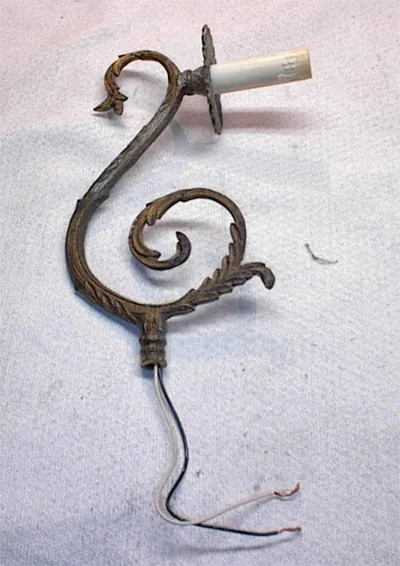
For a service-side view of these stages, our chandelier restoration step-by-step page shows the shop process on real fixtures.
Why Antique Fixtures Must Be Rewired to Code
This is the part owners underestimate most. A beautiful old chandelier can hide wiring that is a genuine hazard, and the metal finish means nothing if the fixture is not safe to energize.
Vintage gas or electric lights should be rewired and their sockets replaced, and refurbished fixtures must use UL-listed parts, as This Old House advises. In New York City, that rewiring has to satisfy the NYC Electrical Code, which is the National Electrical Code as amended by the city. A licensed electrician handles the final connection when the fixture goes back up.
The reason is not red tape. Old cloth-insulated wiring goes brittle over decades of heating and cooling, then cracks and flakes off, exposing live conductors and creating a short-circuit and fire risk. Many antique fixtures also predate modern grounding. Rewiring replaces all of that with modern conductors, sockets, and connections rated for the load.
Landmark Buildings and the Preservation Commission
If your building carries a landmark designation, the paperwork side matters as much as the shop work. It pays to know the rule before a project starts.
Owners generally need a permit from the NYC Landmarks Preservation Commission before work that affects a designated landmark, including designated interior landmarks. Those protected interiors are the publicly accessible spaces the city has singled out, such as grand lobbies, theaters, and terminals. A chandelier in one of those rooms is not just a fixture, it is part of a protected space.
Getting the sequence right, permit first, keeps a restoration on schedule. Our guide on what building owners and architects should know about architectural metal restoration covers how this fits into a larger project.
Protecting the Finish After Restoration
Restoration is not the end of the story. The finish that leaves the shop looking perfect needs a plan to stay that way, and that plan is mostly about lacquer.
A clear lacquer coat seals polished brass and bronze from air and moisture so it holds its shine instead of tarnishing within months. That protection lasts for years, though the exact life depends on the environment, the handling, and the quality of the original prep. When lacquer finally dulls or fails, the fix is to strip and renew it rather than let bare metal corrode.
Between those cycles, high or hard-to-reach fixtures benefit from periodic professional cleaning in place. Our on-site chandelier cleaning service keeps a restored fixture bright without taking it down.
Have a fixture that deserves better than a replacement? We restore chandeliers and architectural lighting for buildings across NYC and the tri-state area, metal finishing and code-compliant rewiring under one roof.
What Does Chandelier Restoration Cost?
Owners always ask for a number first, and the honest answer is that it depends on the fixture in front of us. The range is real, so restoration is quoted per piece.
A single wall sconce is a modest job. A crystal-heavy ballroom fixture or a massive theater chandelier is a major one, both in labor and in the scope of rewiring. For a sense of the high end, our case study on the Beacon Theatre’s 900-pound chandelier shows what large-scale restoration involves.
The drivers are consistent: the fixture’s size, its metal, the crystal or glass count, the condition of the wiring, and any parts that need re-plating or fabrication. That is why the first step is always an assessment, not a flat price.
Common Questions About Chandelier Restoration in NYC
Building owners, managers, and boards tend to ask the same questions before they hand over a fixture. Here are straight answers for the ones we hear most.
Can an antique chandelier be rewired without changing how it looks?
Yes. Rewiring replaces the internal wiring, sockets, and connections while keeping the original arms, body, and crystals. The fixture looks the same, but it is safe to energize and meets current code. Preserving the appearance while updating the electrical is the core of the job.
Do old chandeliers really need new wiring?
In almost every case, yes. Decades-old cloth or rubber insulation grows brittle, cracks, and exposes live wire, which is a shock and fire risk. Rewiring with new sockets and UL-listed parts to the NYC Electrical Code is the difference between a showpiece and a hazard.
Do I need a permit to restore a fixture in a landmark building?
Often, yes. Work affecting a designated landmark, including a designated interior landmark like a lobby or theater, generally needs a permit from the NYC Landmarks Preservation Commission before it begins. It is worth confirming a building’s status early so the timeline accounts for it.
How long does chandelier restoration take?
It depends on size, condition, and the amount of rewiring or re-plating involved. A single fixture is a shorter turnaround than a large crystal chandelier that must come down in pieces. The assessment sets a realistic timeline before work starts, so there are no surprises.
Will the restored finish tarnish again?
Not for a long time if it is sealed properly. Fresh lacquer protects polished brass and bronze for years. When that coating eventually dulls, renewing the lacquer brings the shine back without harming the metal underneath.
Can you clean a chandelier without taking it down?
For maintenance between restorations, yes. On-site cleaning keeps a high or hard-to-reach fixture bright in place. A full restoration, with stripping, polishing, and rewiring, is shop work, but routine cleaning does not have to be.
Ready to bring a chandelier back to life? Metal Man restores architectural lighting for co-ops, houses of worship, hotels, theaters, and landmark interiors across New York City, with metal finishing and code-compliant rewiring handled together.