

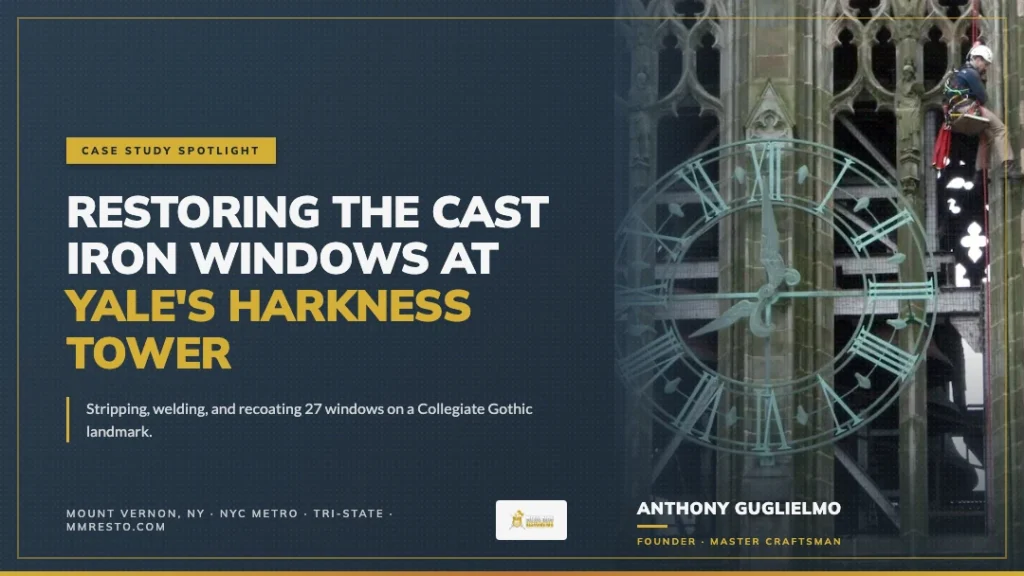
Restoring the Cast Iron Windows at Yale’s Harkness Tower
In June 2009, my team at Metal Man Restoration was hired to restore the cast iron windows at Yale University’s Harkness Tower in New Haven, Connecticut. A landmark Collegiate Gothic structure built between 1917 and 1921, the tower’s windows came to us heavy with old paint and in need of repair. In just over three weeks we returned 27 fully restored windows.
The short version
- The project: the cast iron windows at Yale University’s Harkness Tower, a Collegiate Gothic landmark built between 1917 and 1921 as part of the Memorial Quadrangle.
- Hired in June 2009. The windows were removed and brought to our facility.
- Condition: a heavy accumulation of paint plus minor structural damage that needed repair.
- We used a chemical bath to strip the paint, then bead blasting to clear rust scale and residue down to sound metal.
- We welded the areas that needed reinforcement, then protected the castings with a TNEMEC primer and a urethane top coat built to last decades.
- Completed in just over three weeks: 27 fully restored cast iron windows true to the tower’s character.
Harkness Tower is one of the most recognizable pieces of the Yale campus, and its windows are part of what gives the Collegiate Gothic stonework its rhythm. Cast iron windows from the early 1900s are built to last, but only if the paint and rust that hide them get dealt with properly. That was the job here.
What We Restored
The assignment was the tower’s cast iron windows, removed from a structure built between 1917 and 1921 as part of Yale’s Memorial Quadrangle. The windows came to our facility so each one could be stripped, repaired, and refinished off-site under controlled conditions, then returned ready to reinstall.
The Condition: A Century of Paint and Rust
The windows arrived in poor condition. They carried a heavy accumulation of paint from decades of recoating, and under it sat rust scale and minor structural damage. Cast iron handles this kind of neglect better than most metals, but the buildup still has to come off and the weak spots still have to be repaired before any new finish goes on.
How We Restored the Windows
We started with a chemical bath to strip every layer of paint, then bead blasted each window to clear the rust scale and paint residue down to sound metal. That gives a clean, even surface and shows exactly where the iron needs help. Where the castings needed reinforcement, we welded the structural areas back to strength.
With the metal clean and sound, we protected it for the long haul. Each window got a TNEMEC primer and a urethane top coat, a coating system built to hold up for decades against weather and use. The whole job came together in just over three weeks, returning 27 fully restored cast iron windows.
Why the Coating System Matters
Stripping and blasting cast iron is only half the work. Bare iron will rust again fast if it is not protected correctly, so the coating system is what makes the restoration last. A high-performance primer and urethane top coat seal the metal against moisture and give years of service before the windows need attention again. The right finish is the difference between a restoration and a repaint.
What This Means for Institutions and Preservation Teams
If your campus or building has original cast iron or steel windows buried under generations of paint, the Harkness Tower project is a useful model. Removing the windows for a controlled strip, repair, and recoat preserves original fabric that is expensive and often impossible to reproduce. It also lets the iron be inspected and reinforced properly. For the broader approach, see our architectural metal maintenance guide for property managers.
Common Questions About Cast Iron Window Restoration
These are the questions facilities managers and preservation architects ask us most about restoring historic metal windows.
Can old cast iron windows be restored instead of replaced?
Almost always, yes. Cast iron is durable, so the original windows are usually worth saving. Stripping the paint, blasting to sound metal, welding the weak spots, and applying a proper coating system returns them to service. At Harkness Tower, all 27 windows were restored rather than replaced.
How do you remove decades of paint from cast iron?
We use a chemical bath to strip the paint layers, followed by bead blasting to clear rust scale and residue down to clean, sound metal. The two steps together remove buildup that hand-scraping never could, without damaging the casting underneath.
Can cracked or damaged cast iron be repaired?
Yes. Structural areas can be welded and reinforced once the metal is clean and the damage is visible. The Harkness windows had minor structural damage that we welded back to strength before refinishing, so the restored windows are sound, not just better-looking.
How long do restored cast iron windows last?
With a high-performance coating system, decades. We finished the Harkness windows with a TNEMEC primer and urethane top coat built for long service. Proper coatings, plus occasional maintenance, are what keep the iron protected and push out the next full restoration.
How do I start a window restoration project?
Send us photos of the windows, the building location, and a note on what you are seeing, paint buildup, rust, or cracked sections. We will tell you honestly if they are candidates for restoration and what the work would involve. You can reach us through our contact page.
Before any of this work begins there is a process to clear. the approval and survey steps behind a landmark project is the part owners tend to learn about last.
Not every cast iron window is as salvageable as these were. We laid out when cast iron is worth saving and when it is time to replace it for owners weighing the same choice on their own buildings.
Have historic metal windows that need expert restoration?
We restore cast iron and steel casement windows, along with architectural and ornamental metal, for universities, institutions, and building owners across the New York metro and the tri-state area.
More from our shop:
- Yale Harkness Tower case study. Our full cast iron window restoration at Yale.
- Architectural metal restoration for building owners and architects. The overview guide for property decision-makers.
- Award-winning bronze restoration at Newark City Hall. A spotlight on our Newark City Hall project.