

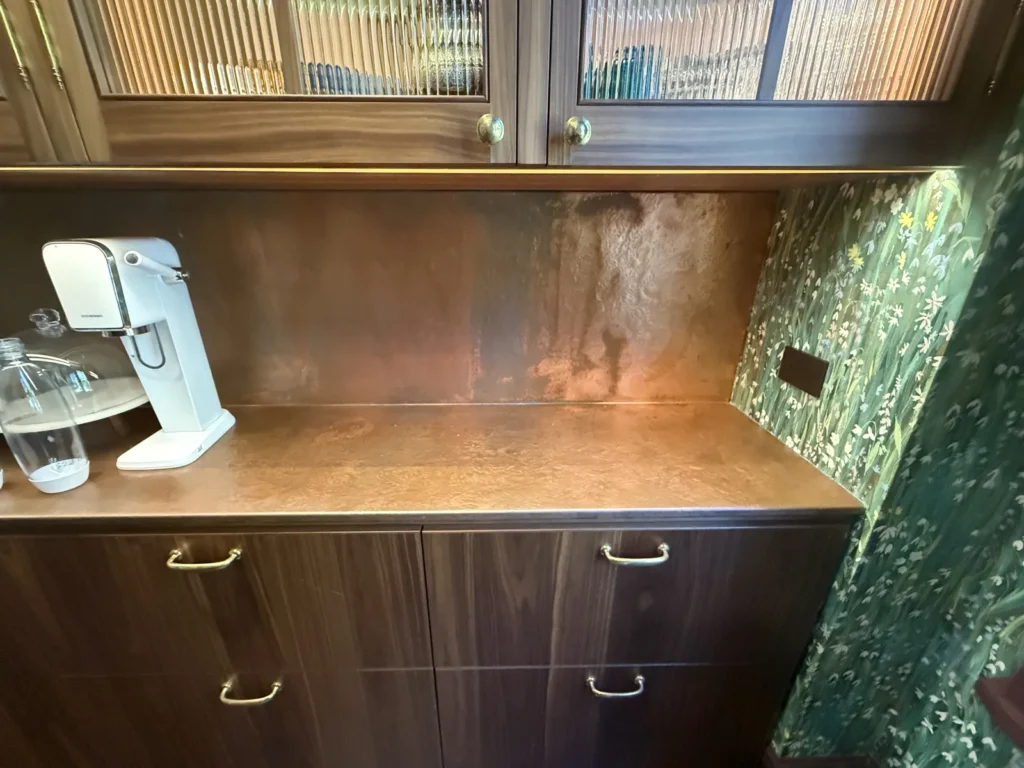
Natural or Chemical Copper Patina: The Short Answer
An authentic patina is the corrosion layer weather builds on copper, turning it from bright to brown to black to green over years or decades, usually unevenly. An artificial patina is developed chemically in a few steps to reach a chosen tone now. Let weather work on new exterior copper with time to spare. Use a chemical patina to match repairs or reach a set color.
TLDR:
- A natural patina forms on its own and moves from brown to black to green.
- The National Park Service says that change can stretch over decades.
- Weathering is uneven, and repairs left to weather can look blotchy for years.
- A chemical patina reaches red-brown, gold-brown, green, blue-green, or black now.
- Repatinating can take off a slight amount of surface metal, so it is not free.
- A sound, even natural patina protects copper and is worth keeping.
- Wax or lacquer keeps copper bright, because the patina will not form under it.
New York is full of copper and its alloys that weather has already colored. Cornices, roof ridges, and bronze entrances in Manhattan, Brooklyn, and the Bronx all show it. When a piece is repaired or replaced, it comes back bright and sits next to metal that took decades to darken. That is usually the moment someone asks if they should wait for nature or patinate it now.
Not sure if your copper needs a patina, a cleaning, or nothing at all? Send photos of the piece, the areas that look wrong, and anything next to it that it should match. We will tell you which route fits before you commit.
What an Authentic Copper Patina Actually Is
A natural patina is not a stain or a coating. It is a thin layer of corrosion that copper grows on itself, and it changes color as it matures.
The National Park Service’s Metals in America’s Historic Buildings, revised in 1992, describes copper as “initially a bright reddish-brown.” Exposed to the atmosphere, it “acquires a protective patina that turns from brown to black to green over a period that may extend for decades, depending on environmental conditions.”
Why it protects the copper
The same survey calls the patina “a thin, tough layer of corrosion that usually prevents deeper and deeper layers of corrosion.” That is why copper can corrode and still be one of the most durable metals on a building. A sound, even patina is doing a job, not just changing the color.
Why it comes in uneven
Weather does not hit a building evenly. Describing a natural patina forming on the bronze of a Manhattan bank, the NPS notes the colors “are usually uneven and streaked because of the local pattern of wind and rain.” Sheltered areas lag behind exposed ones, and runoff paths color first. That unevenness is part of the look, and it is also the main reason people turn to a chemical patina.
What an Artificial Copper Patina Is
An artificial patina is the same family of colors, produced on purpose. The surface is cleaned, then treated chemically, so the color develops in the shop instead of on the roof.
The NPS lists the color range of chemically induced bronze patinas as “red-brown, gold-brown, shades of green or blue-green, and black.” It adds that what matters most to the eye is often the subtle variation within a color, which “can enhance highlights and shadows.” A good chemical patina is not one flat color. It is built up and adjusted until it reads like aged metal.
How it differs from paint
A patina is developed into the metal itself. Paint sits on top of it. On our Newark City Hall restoration, the exterior bronze lighting fixtures were stripped, glass-bead blasted back to clean bronze, and oxidized to a statuary patina. That 2006 work earned the New Jersey Historical Restoration Award.
Where it is offered on copper
On plated work, a patina can be the finish itself. Our copper plating service is done in a polish, satin, or patina finish, over nickel, steel, bronze, stainless steel, and zinc die castings, all in-house. Knowing both routes, the real question is which one fits the piece in front of you.
When an Authentic Patina Makes Sense
Let the weather do the work when time is on your side and nothing nearby has to match on day one.
New exterior copper with time to spare
A new roof, cornice, or flashing that stands on its own has nothing to match. Leave it bare, and it will start to darken, then move toward green over the years, on its own terms. The trade-off is control: you get the color the building’s wind and rain give you, in the pattern they give it.
Sound old patina worth keeping
If an existing patina is even and tight to the surface, it is protecting the metal, and stripping it throws that away. The NPS is direct about this: “All cleaning removes some surface metal and patina; therefore, it should not be done without good reason.” On a historic building, the Secretary of the Interior’s Standards for Rehabilitation add that distinctive finishes “shall be preserved.”
When natural patina is not doing its job
Not every old patina deserves to stay. The NPS notes that “severe pitting and obvious loss of material from corrosion are good indications that the patina is not protective.” One customer described a copper coffee table base whose “beautiful patina took on a blotchy brown appearance with some obvious corrosion” before we refinished it. That is where a chemical patina, or a bright finish, comes in.
When an Artificial Patina Makes Sense
A chemical patina earns its place when the color has to be right now, or has to match something that is already old.
Repairs and replacements that must match
This is the most common case. The NPS notes that heat from brazing or welding will affect the patina, “causing a change in color that may be permanent,” and stripped or new sections start out bright. The NPS says a removed patina “can be replaced slowly by weathering which takes 8-10 years; however, the resulting blotchiness may not be acceptable.” It adds that the patina “can be replaced rapidly by chemical means to match the rest of the work.”
That is how our metal repair and fabrication shop handles aged pieces: on deliberately patinated or heavily aged work, we match the age rather than the factory finish. On the Church of the Assumption bronze doors, missing finials were re-cast and the team re-applied an oxidized patina matched to the doors’ original tone.
Pieces that will never see weather
Indoors, copper is sheltered from the wind, rain, and pollution the NPS links to how a patina forms. If the design calls for an aged tone, a chemical patina is the way to get it, then wax or lacquer to hold it. Our antique and architectural lighting restoration works the same way: where a fixture should keep its age, we match the existing patina rather than making it look new.
The cost of a chemical patina
It is not free of trade-offs. The NPS notes that “repatination may also remove a slight amount of surface metal.” On a sound piece, that loss is small. It is still a reason to patinate only what needs it, rather than redoing a whole element to fix one patch.
Have a repair that came out bright next to dark or green copper? Send photos of the new section and the older work beside it. We will tell you if a matched patina makes sense and what it would involve.
When to Skip the Patina and Keep Copper Bright
Some owners want neither route. They want copper to look like copper.
Clear coats stop the patina from forming
The NPS explains that copper cleaned of oxide and protected by lacquer “will retain its original color for a number of years; the natural protective patina will not form, except where the coating is broken or worn away.” Wax coatings can also be used. The catch is upkeep: it gives waxes six-month to two-year intervals and lacquers three- to five-year intervals on architectural bronze.
Kitchens, bars, and sinks
In a home, darkening copper is often the problem, not the goal. In October 2026, we polished a copper kitchen sink onsite in Park Slope, Brooklyn that had oxidized to a dark, blotchy finish, bringing it back to bright copper. Our copper and brass cleaning and maintenance keeps that kind of finish on a schedule.
A quick way to choose
Use the table below as a first pass. The first row that fits is usually the right call.
| Situation | Best route | Why |
|---|---|---|
| New exterior copper, no matching needed | Authentic patina | Weather colors it for free, on its own schedule |
| Old patina that is even and tight | Keep it | It protects the metal, and cleaning removes some |
| Patina that is pitted or flaking | Clean, then patinate or finish | It has stopped protecting the copper |
| Repair or new section next to aged work | Artificial patina | Weathering can take 8 to 10 years and look blotchy |
| Interior copper that should look aged | Artificial patina, then wax or lacquer | It is sheltered from the weather that drives a patina |
| Copper meant to stay bright | Polish, then wax or lacquer | The coating stops the patina forming |
If two rows seem to fit, the piece usually needs a closer look before anyone picks up a chemical or a buffer.
What New York Copper Teaches About Patina
The city is a long-running test of copper patina, and the NPS survey uses several local buildings to show how it behaves.
The Statue of Liberty
Its copper skin is thin. The NPS lists the thickness of the copper sheeting as 3/32 of an inch, “the thickness of two pennies placed together.” The Metals in America survey notes that “little damage had occurred to the copper at The Statue of Liberty.” The damage there was to the iron armature, where salty rainwater connected it to the copper.
When patching goes wrong
The same survey shows the Dakota Apartments, where corrosion of a copper roof ridge “was caused by the use of an asphalt roofing compound for temporary patches.” The lesson carries to every owner in the city: what goes onto copper matters as much as what grows on it. Our architectural metal restoration work refinishes by polishing, plating, or building an appropriate patina, then seals it with lacquer or wax.
Common Questions About Copper Patina
These are the questions owners, architects, and designers ask when they are choosing between letting copper age and patinating it. Most of them come down to time, evenness, and what the piece has to match.
How long does it take copper to develop a natural green patina?
It depends on exposure. The National Park Service says copper turns from brown to black to green over a period that may extend for decades, depending on environmental conditions. Wind, rain, and pollution all change the pace, so two sides of the same building can age at very different rates.
Is an artificial patina the same as painting copper?
No. A chemical patina develops color in the metal itself, the same way weather does, only faster and with control. Paint is a separate layer on top. That is why a patina reads as aged metal, while paint over copper tends to look like paint, and wears differently as it ages.
Can you match new copper to old patinated copper?
Usually, yes. A chemical patina can be built up and adjusted until a repair or new section sits beside the old work. The NPS notes that leaving a repair to weather can take 8 to 10 years and look blotchy, while a chemical patina can match the rest of the work much sooner.
Does a patina protect copper or damage it?
A sound patina protects it. The NPS calls it a thin, tough layer of corrosion that usually prevents deeper corrosion. A patina with severe pitting and obvious metal loss is a different story, because it has stopped protecting the copper and the cause needs to be found and treated.
Can I keep copper from turning green?
Yes. Copper that is cleaned and sealed with lacquer keeps its original color for a number of years, because the natural patina does not form under an intact coat. The coating needs upkeep, though. Wax needs renewing more often than lacquer, and any break in the coat lets the patina start there.
Should I remove an old patina from historic copper?
Only with good reason. Cleaning removes some surface metal and patina, and an even, adherent patina is protecting the metal. If it is pitted, flaking, or covered in old coatings and grime, cleaning and a matched patina may be the right call, and the decision should be made in person.
Related guides in this series:
- Bronze vs. brass vs. copper restoration: why each copper alloy restores differently.
- Brass restoration vs. polishing vs. replating: which treatment a dull or worn brass piece needs.
- The Statue of Liberty and the power of metal: the copper landmark most New Yorkers know by its color.
- Identifying original metal on a historic building: how to tell original work from later replacements.
- Architectural metal maintenance for property managers: keeping restored metal in shape between projects.
Not sure if your copper should be left to age, be patinated, or stay bright?
Send photos to metalman@mmresto.com, including the area in question and anything it needs to match. We will tell you honestly which route fits, what the finished color will look like, and if it is worth doing, before you commit to anything.