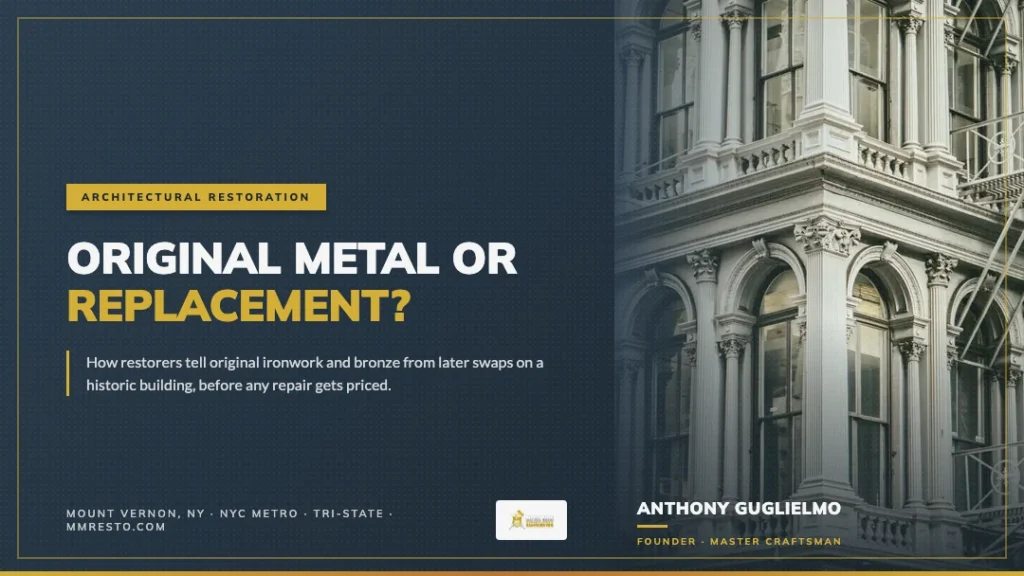
How to Tell Original Metal From a Replacement: The Short Answer
Start with the building’s history, then read the metal itself. Old photographs show what was there. Casting marks, joints, weight, a magnet, and the paint layers show what is there now. Original cast iron is uniform, bolted together, and carries mold lines, while wrought iron is riveted or forge welded. Later replacements often turn out to be steel, aluminum, fiberglass, or concrete.
TLDR:
- The answer decides the repair. Historic standards say original features get repaired, not replaced.
- Old photographs come first. New York City has a 1940 photo of every building.
- Cast iron shows mold lines and bolts. Wrought iron shows rivets and hand work.
- A magnet separates iron and steel from aluminum, bronze, brass, and copper.
- Fiberglass and concrete replicas feel and sound different from metal.
- Paint layers record age. A replacement carries fewer of them.
- Scrape-testing and spot paint removal settle what a visual check cannot.
Most of the buildings we work on in New York City, Westchester, and the tri-state area have been repaired more than once. A railing section was replaced after a car hit it, a cornice bracket was recast in the 1970s, a set of bronze doors got new hardware in the 1990s. A century of paint makes all of it look the same. The first job on any restoration is sorting out what is original and what was added later, because the two get treated differently.
Not sure what is original on your building? We survey architectural metal on site across Mount Vernon, New York City, and the tri-state area.
Why It Matters Which Metal Is Original
The answer changes what you are allowed to do and what you should do.
The Secretary of the Interior’s Standards for Rehabilitation say that deteriorated historic features “shall be repaired rather than replaced.” When a distinctive feature has to be replaced, the new one should match the old in design, color, texture, and, where possible, materials. The same standard says replacing a missing feature should be “substantiated by documentary, physical, or pictorial evidence.”
That last line is why identification comes first. If a bracket is original, it gets repaired. If it is a 1980s replacement in the wrong material, there may be a case for correcting it, but only with evidence of what was there before.
In New York City, a designated building adds a second layer. The Landmarks Preservation Commission requires owners to obtain permits before doing work that affects the exterior of a designated landmark. An application that says “repair the original cast iron” and one that says “replace the later aluminum” are very different filings.
Our guide to what building owners and architects should know about architectural metal restoration covers the wider project, from survey to approvals.
Start With the Paperwork, Not the Metal
Before anyone touches the ironwork, the building’s own records usually answer half the question.
Old photographs. Between 1939 and 1941, the city photographed every building in the five boroughs for tax assessment. The 1940s tax photographs at the NYC Municipal Archives are online and searchable by block and lot. For many buildings they are the clearest early image that exists. Compare the railings, cornice, storefront, and entrance in that photo against what stands today.
Drawings and permits. Original architectural drawings, later alteration permits, and any landmark designation report can name the materials and date the changes.
The owner’s own files. Invoices from past repair work often say exactly which sections were replaced and when. They are worth asking for before the survey.
None of this replaces looking at the metal. It tells you where to look hardest.
Read the Metal Itself: Cast Iron, Wrought Iron, and Steel
Iron work on older buildings is usually one of three materials, and each leaves its own marks.
The National Park Service’s Preservation Brief 27 on architectural cast iron gives the clearest field guide. Cast iron “often contains mold lines, flashing, casting flaws, and air holes.” Cast elements are “very uniform in appearance and are frequently used repetitively,” and they are “often bolted or screwed together.”
Wrought iron is the opposite. The same brief describes it as “simpler in form and less uniform in appearance,” with “evidence of rolling or hand working.” Wrought-iron pieces “are either riveted or forge-molded (heat welded) together.”
Steel is the modern stand-in. Brief 27 notes that mild steel “is now used to fabricate new hand-worked metal work and to repair old wrought-iron elements.” So a railing that looks hand-forged but has crisp, uniform bar stock and welded joints is often a later steel fabrication or a steel repair spliced into older iron.
For more on how those three metals behave in repair, see our guides to cast iron restoration versus replacement and restoring wrought iron railings and ornamental ironwork.
The Magnet Test and Other Quick Checks
Some of the most useful checks need nothing more than a magnet and your hands.
A magnet. Iron and steel are magnetic. Aluminum, bronze, brass, and copper are not. On a painted railing or column, a magnet that falls away is the fastest sign that a piece is not iron, whatever it looks like.
Weight and feel. Cast iron is heavy. Brief 27 lists the common substitutes for cast iron as “cast aluminum, epoxies, reinforced polyester (fiberglass), and glass fiber-reinforced concrete (GFRC).” The brief notes that aluminum is lighter in weight than cast iron and that fiberglass is usually a thin, rigid shell, so both feel light for their size. GFRC is a lightweight concrete and feels like stone rather than metal.
Repetition with small differences. Original cast iron was poured from the same patterns, so matching units are nearly identical. A replacement cast from a mold taken off a surviving piece can show slightly softer detail than the originals beside it, so compare matching units side by side.
A scratch in a hidden spot. On bronze and brass hardware, a small scratch somewhere out of sight shows the base metal. Solid bronze stays bronze. A plated replacement shows a different color underneath. Our guide on how bronze, brass, and copper differ in restoration explains why that matters for refinishing.
Joints, Fasteners, and Welds Tell the Age
How a piece is attached often dates it more reliably than how it looks.
Original cast iron facades were cast as separate parts and bolted together. Brief 27 describes the first iron-front buildings in Lower Manhattan being “hoisted into position, then bolted together and fastened to the conventional structure of timber and brick with iron spikes and straps.” Original wrought iron is riveted or forge welded.
A continuous weld bead running along a joint usually marks a later repair or a newer fabrication. Shiny modern fasteners, threaded rod, and expansion anchors in masonry point the same way. None of these prove a whole element is a replacement, but they show where someone has worked on it, and that is where to look closer.
Paint Layers Hold the History
Paint is a record as much as a finish.
An element that has been on the building since the 1880s has usually been painted many times. A section that was swapped in during the 1990s carries only the coats applied since then. When a small area is cleaned back carefully, the number of layers and their colors can separate original pieces from newer ones sitting right beside them.
Brief 27 makes the same point about inspection: “Removal of select areas of paint may be the only means to determine the exact condition of connections, metal fasteners, and intersections or crevices that might trap water.” The same spot removal that shows condition also shows age.
Tests That Settle the Question
Some answers only come from testing a small area.
The knife test for weakened cast iron. Cast iron left unpainted for long periods can graphitize, keeping its shape while losing its strength. Brief 27 explains that this is identified “by scraping through the surface with a knife to reveal the crumbling of the iron beneath.” An original casting that crumbles under the knife is a different conversation from one that is sound.
Contact between different metals. Brief 27 warns that aluminum placed in contact with or near cast iron “may result in galvanic corrosion.” Finding a replacement in a different metal tells you what to fix as well as what to identify, because the joint between them can be where the next failure starts.
Close inspection of every element. Scaffolding or a lift, a camera, and a written condition record for each piece. On a facade, that is the survey that every later decision rests on. Our article on what happens on a NYC landmark metal restoration shows where it fits in the schedule.
What to Do With What You Find
Once each element is identified, the plan mostly writes itself.
Original metal in repairable condition gets repaired. Original metal that is beyond repair gets replicated in kind, matching the old in design and, where possible, material. Later replacements in the right material that are performing well can stay. Later replacements in the wrong material, or ones causing galvanic damage, are candidates for correction, backed by the photographs and physical evidence that show what belongs there.
Write it all down. A marked-up elevation or photo set showing original, replaced, and repaired elements is worth keeping for the next owner and the next restoration. See our work on landmark buildings for the kinds of projects where this survey comes first.
Common Questions About Identifying Original Architectural Metal
These are the questions owners, architects, and property managers ask us when they are trying to work out what on their building is original.
How can you tell if ironwork on an old building is original?
Compare it against old photographs first, then look at the metal. Original cast iron shows mold lines, uniform repeated units, and bolted joints. Original wrought iron shows hand work, rivets, and forge welds. Welded joints, uniform modern bar stock, and newer fasteners usually mark later work or repairs.
Does a magnet tell you if metal is cast iron?
A magnet sorts iron and steel, which both attract it, from metals that do not, such as aluminum, bronze, brass, and copper. It cannot tell cast iron from wrought iron or steel. For that, look at casting marks, joints, and how the piece was made.
Where can I find old photos of a New York City building?
The NYC Municipal Archives has tax photographs of every building in the five boroughs taken between 1939 and 1941, searchable online by block and lot. Landmark designation reports, old permits, and building files can add drawings and dates. Past repair invoices often show which sections were replaced.
Are aluminum or fiberglass replacements a problem?
They can be. The National Park Service notes that aluminum near cast iron may cause galvanic corrosion, fiberglass is easily damaged by impact, and these materials were not used historically with cast iron. On a designated building, the right material for any replacement is part of the landmark approval.
Should later replacement metal be removed during a restoration?
Not automatically. A later replacement in the right material that is performing well can stay. One in the wrong material, or one damaging the original metal around it, is a candidate for correction. Historic standards ask for documentary, physical, or pictorial evidence before restoring a missing feature.
Related guides in this series:
- Architectural metal restoration for building owners and architects: what to know before a restoration starts.
- Cast iron restoration versus replacement: the five questions that decide it.
- Restoring railings, canopies, and facade metal: the full range of architectural metal we restore.
Want to know what is original on your building before you plan the work?
Send us photos and a note on the building’s age and history. We will tell you what looks original, what looks like later work, and what a proper survey would confirm, working on site and in our Mount Vernon shop across NYC and the tri-state area.