
How a Landmark Metal Restoration Project Actually Works
A landmark metal restoration runs in a fixed order: confirm the building’s designation status, survey the existing metal and document its condition, secure the required Landmarks approval, then decide element by element what gets repaired, what gets replicated, and what gets left alone. Fabrication and field work follow. The approval step is the one that sets the calendar, and it is the step most owners learn about last.
TLDR:
- Designation status decides the process. Confirm it before you price anything.
- The survey comes before the estimate. A number produced without one is a guess.
- Landmarks approval sets your timeline more than the metalwork does.
- Repair beats replication when enough original material survives, and it usually does.
- Shop work and field work are different trades. Most projects need both.
- The finish, not the metal, is what typically fails first on a restored element.
- What happens after the scaffold comes down decides how long any of it lasts.
Most building owners meet the Landmarks Preservation Commission for the first time because something has already started failing. A bronze door is binding, a cornice is streaking rust down the limestone, a set of cast iron windows has been painted shut for forty years.
By then the sequence is set, and the parts that feel like delay are usually the parts protecting the building.
Working on a designated building in New York City?
Metal Man Restoration has handled landmark metalwork on civic buildings, theaters, churches, and campuses across the five boroughs and the tri-state area. Send us photographs, and we will tell you what you are looking at.
First, Confirm What You Are Actually Dealing With
Two buildings on the same block can sit under completely different rules, and the difference changes everything downstream.
An individually designated landmark, a building inside a historic district, and an undesignated building of the same age are three separate situations. The Landmarks Preservation Commission maintains the record of what is designated in New York City, and that is the first thing to check.
Interior designation exists too, and it catches people out. A lobby can be protected while the exterior is not.
Get this settled in writing before anyone prices the work. A scope built on the wrong assumption has to be rebuilt from scratch.
The Survey Comes Before the Estimate
An estimate produced from photographs alone is a guess with a number attached to it. On landmark work, that guess is usually wrong in both directions.
A real survey means someone at the element, in person, at height where necessary. What alloy is this? How much original material survives? Is the corrosion surface or structural? What has been done to it before, and what did that previous repair do to the metal underneath?
That last question matters more than owners expect. Decades of well-meant maintenance leave a record: incompatible coatings, filled cracks, mismatched fasteners, a brass element painted to look like bronze.
The survey produces the condition documentation the Commission will want anyway. Doing it first means you are not paying for it twice.
What the Commission Wants to See
Approvals feel opaque from the outside and are fairly consistent from the inside.
New York City requires a permit for work on designated buildings. The LPC issues several permit types depending on the scope of the work, running from administrative approvals for straightforward in-kind repair through to a Certificate of Appropriateness for changes that need a public hearing.
What moves an application along is specificity. Photographs of existing conditions, a clear statement of what is failing and why, samples or specifications for any replacement material, and a proposed finish with a stated rationale.
What slows an application down is vagueness. “Restore metalwork as needed” invites questions. “Repair in kind, retaining original material where sound, replicating only the four sections documented as unsalvageable in the attached survey” answers them.
Build the approval package out of the survey. They are the same information presented for two audiences.
Repair, Replicate, or Leave Alone
This is the decision that separates restoration from replacement, and preservation practice leans hard in one direction.
The Secretary of the Interior’s Standards for the Treatment of Historic Properties favor retaining and repairing historic material over replacing it, and replacing in kind only where deterioration makes repair impractical. Most reviewers apply the same logic.
In practice, on architectural metal, that means:
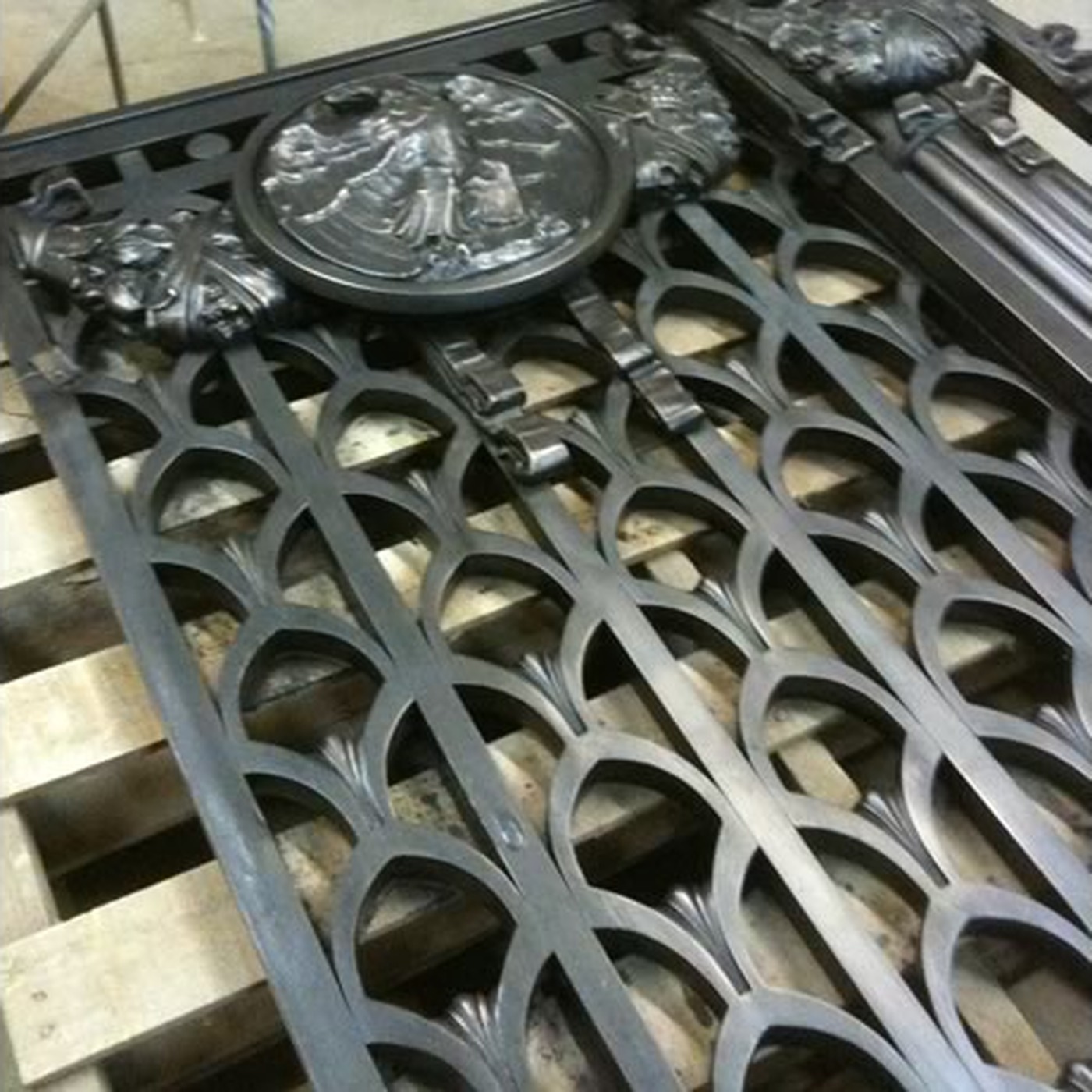
- Repair where the original material is sound enough to carry on. Most bronze and cast iron survives far better than it looks under a century of coatings and corrosion.
- Replicate individual failed sections from the surviving original as the pattern, matching alloy, profile, and finish.
- Leave alone where the surface tells the building’s story and stabilizing it is enough. Not every patina is damage.
The instinct to replace a whole assembly because part of it failed is the expensive instinct, and it is usually the one the Commission pushes back on.
Shop Work and Field Work Are Different Jobs
A landmark project almost always splits across two places, and knowing which is which helps you read a schedule.
Elements that can come down safely go to the shop, where stripping, straightening, welding, casting, plating, and finishing happen under controlled conditions. Doors, gates, hardware, light fixtures, plaques, and window sash typically travel.
Everything else is treated in place from scaffold or lift. Cornices, facade panels, railings, and anything structural stay put, which means weather and site access become part of the schedule.
Our plating work on brass, chrome, nickel, and copper is shop work by definition. Facade restoration rarely is.

The Finish Is What Fails First
Owners tend to think of the metal as the fragile part. On a restored element, the finish almost always goes first.
A coating chosen for appearance rather than exposure will look right for a season and chalk, streak, or lift after a few New York winters. Salt, sulfur, and freeze-thaw cycling are unforgiving on anything specified casually.
Finish selection should account for orientation, rain exposure, handling, and the maintenance the building can realistically commit to. A high-touch bronze door handled thousands of times a day needs a different answer than a cornice nobody will reach again for twenty years.
If you want the material-by-material version of this, our guide to how bronze, brass, and copper behave differently in restoration covers where each one is forgiving and where it is not.
Where the Months Actually Go
Owners are usually surprised by the shape of a landmark schedule rather than its length.
The metalwork itself is often the shortest phase. Survey and documentation take weeks. Approval takes as long as the review path requires, and an application needing a public hearing runs on the Commission’s calendar rather than yours. Fabrication of replicated elements depends on casting and finishing time. Field work depends on scaffold, access, and weather.
Two things shorten the whole sequence more than anything else. A complete first submission, and a contractor who has been through the process on comparable buildings and is not learning it on yours.
Two things lengthen it. Hidden conditions that surface after approval, which a proper survey mostly prevents, and starting the conversation after a deadline has already been set by someone else.
What This Looks Like on Real Buildings
The sequence above is easier to picture against work that has been through it.
- Newark City Hall bronze restoration, an award-winning civic project.
- The 1843 bronze doors at the Franciscan Church of the Assumption, where the original material long predates the building’s modern use.
- Cast iron windows at Yale’s Harkness Tower, a campus landmark with heavy weather exposure.
- Bronze gates at the Alexander Hamilton Custom House, a federal building with public access to work around.
- The Beacon Theatre chandeliers, shop work on fixtures that had to return to a working venue.
- The Art Deco facade of the Niagara Mohawk Building, facade work at height on a period-specific finish.
Different buildings, same order of operations.
After the Scaffold Comes Down
A restoration is a starting condition, not a permanent one, and this is where most of the value is won or lost.
Restored metal that gets washed on a schedule, inspected annually, and touched up early will hold for decades. The same metal left alone until something visibly fails is on its way back to where it started, at full cost.
A written architectural metal maintenance program is the cheapest part of the entire project and the part most often skipped. For property managers inheriting a building rather than commissioning the work, our maintenance guide covers what to watch for between visits.
Questions Building Owners Ask About Landmark Metal Work
The things that come up most often on a first walkthrough.
How do I find out if my building is a designated landmark?
Check the Landmarks Preservation Commission’s records for the address. A building can be individually designated, sit inside a historic district, or have a designated interior, and each carries different obligations. Confirm it in writing before scoping any work.
Do I need approval to repair metal exactly as it was?
Usually yes, though straightforward in-kind repair typically follows a faster administrative path than work that alters appearance. The permit type depends on the scope, so describe the work precisely when you apply rather than generically.
Is it cheaper to replace historic metal than restore it?
Rarely, once the full picture is counted. Replication of ornamental metal means new patterns, castings, and finishing, and on a designated building it also means a longer approval path. Repair usually wins on both cost and schedule where enough original material survives.
How long does a landmark metal project take?
The metalwork is often the shortest phase. Survey, approval, and fabrication set the calendar, and an application requiring a public hearing runs on the Commission’s schedule. Start earlier than feels necessary.
Can restored metalwork be matched to what is already on the building?
Yes, and that matching is a normal part of the work. Alloy, profile, and finish are all specified against surviving original material, which is one more reason the survey happens first.
Who should be involved besides the metal contractor?
On most designated buildings, an architect or preservation consultant leads the application while the restoration contractor supplies condition documentation, samples, and specifications. Bringing the metal contractor in before the application is written prevents a scope that cannot be built as described.
Have a designated building with metal that needs attention?
Send us photographs of the elements you are worried about and tell us what you know about the building’s status. We will tell you what is likely repairable, what would need replication, and what the approval path probably looks like before you commit to anything.