Restoring the Wrought Iron Entrance at The Admaston
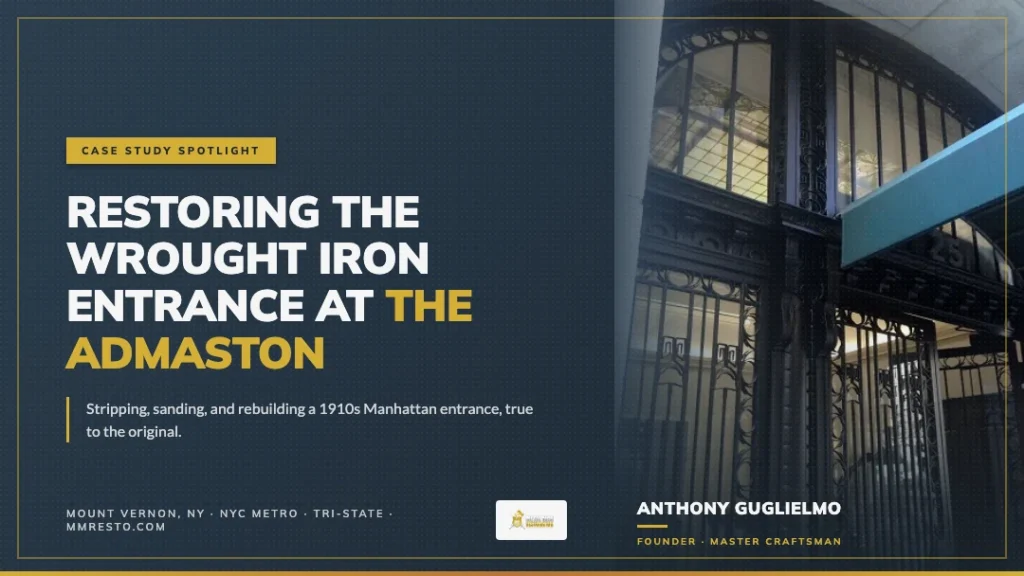
In August 2015, my team at Metal Man Restoration was hired to restore the front entranceway of 251 West 89th Street in Manhattan, known as The Admaston, a pre-war building constructed between 1910 and 1911. The wrought iron had never been restored and carried deep pitting and rot under generations of paint. Here is how we rebuilt it.
The short version
- The project: the front entranceway of 251 West 89th Street in Manhattan, known as The Admaston, a pre-war building constructed between 1910 and 1911.
- The wrought iron entranceway had never been restored.
- Our analysis found many layers of paint down to the original coat, plus rotted areas and deep pitting where corrosion had worn through the iron.
- We stripped every layer of paint to expose the bare metal.
- We sanded out the pitting and metal-filled the worn and rotted areas to rebuild the iron’s profile.
- The two-month project returned the entrance to a clean, structurally sound condition true to the building’s 1910s character.
A pre-war wrought iron entrance is one of the first things you notice about a building like The Admaston, and one of the easiest to lose. Decades of repainting hide the corrosion underneath, and by the time the iron looks tired, the metal itself has often started to go. Saving it means getting back to bare metal and rebuilding from there.
What We Restored
The assignment was the building’s front entranceway, the wrought iron that frames the entrance to The Admaston. Built between 1910 and 1911, the entrance had never been restored, so this was the first time the iron had been taken back to bare metal in more than a century of New York City weather.
The Condition: Corrosion Under the Paint
Our initial analysis found many layers of paint, going all the way down to the original coat. Under that paint sat the real problem: rotted areas and deep pitting where corrosion had worn through the original wrought iron. Paint hides this kind of damage, which is why a wrought iron entrance can look like it just needs a fresh coat when it actually needs structural repair.
How We Restored the Entrance
The two-month restoration started by stripping every layer of paint to expose the bare metal. Only with the iron fully uncovered could we see the true extent of the pitting and rot and plan the repairs. Stripping first, then assessing, is the only honest way to restore iron that has been painted over for a century.
From there, we sanded out the pitting and metal-filled the worn and rotted areas to rebuild the iron’s profile. That returned a sound, smooth surface ready for refinishing, with the original lines of the entrance intact. The work brought the historic entranceway back to a clean, structurally sound condition true to the building’s 1910s character.
Why Wrought Iron Needs Structural Repair, Not Just Paint
Repainting corroded wrought iron only buries the problem deeper. Pitting and rot keep spreading under the new coat, and the profile of the original ironwork slowly disappears. Stripping to bare metal, then sanding and metal-filling the damage, rebuilds the iron itself so the refinished surface sits on something solid. That is the difference between a restoration that lasts and a paint job that fails in a season.
What This Means for Pre-War Building Owners
If your pre-war building has a wrought iron entrance that has only ever been repainted, the Admaston project is a useful warning and a useful model. The iron is probably hiding pitting and rot under the paint, and the fix is structural, not cosmetic. Done properly, the original entrance is saved rather than replaced with a reproduction. For the broader approach, see our architectural metal maintenance guide for property managers.
Common Questions About Wrought Iron Restoration
These are the questions building owners and managers ask us most about restoring historic wrought iron.
Can corroded wrought iron be restored?
Usually, yes. At The Admaston, the iron had deep pitting and rotted areas under a century of paint, and we rebuilt it. Stripping to bare metal, sanding out the pitting, and metal-filling the damage restores the profile. Only iron that is too far gone to hold a repair needs replacement.
Why strip all the paint first?
Because paint hides the real damage. The Admaston entrance had many layers down to the original coat, masking pitting and rot underneath. Stripping to bare metal is the only way to see the true condition and plan repairs. Painting over corrosion just lets it keep spreading.
What is metal-filling?
It is rebuilding worn and rotted areas of the iron to restore the original profile. After sanding out the pitting at The Admaston, we metal-filled the damaged areas so the surface was sound and smooth again. It rebuilds the iron’s shape rather than just hiding the loss under filler and paint.
Can you restore iron without losing the original design?
Yes, and that is the goal. We rebuilt the Admaston entrance to a sound, smooth condition true to the building’s 1910s character. Careful sanding and metal-filling keep the original lines intact, so the restored entrance reads as the historic ironwork it is, not a modern stand-in.
How do I start a wrought iron restoration?
Send us photos of the ironwork, the building location, and a note on what you are seeing, peeling paint, rust, or pitting. We will tell you honestly if it is a candidate for restoration and what the work would involve. You can reach us through our contact page.
The Admaston was one entrance. For the general sequence behind work like this, our guide to how wrought iron railings and ornamental ironwork get restored covers the survey, paint removal, forge repairs, and refinishing step by step.
Related guides in this series:
- The wrought iron railing restoration process: stripping, repair, and refinishing, step by step.
- Identifying original metal versus replacement on a historic building: old photos, joints, a magnet, and paint layers.
- The NYC landmark metal restoration process, start to finish: designation, survey, approvals, and the work itself.
Have a wrought iron entrance or railing that needs more than paint?
We restore wrought iron, ornamental ironwork, and architectural metal for pre-war buildings and historic properties across the New York metro and the tri-state area.
More from our shop: see the full Admaston entranceway case study, our guide to architectural metal restoration for building owners and architects, and our spotlight on the cast iron windows at Yale’s Harkness Tower.