
Restore or Replace Cast Iron: The Short Answer
Most architectural cast iron should be restored, not replaced. Surface rust, failed paint, and many cracks are repairable, and ornamental castings often cannot be sourced again once they are scrapped. Replacement makes sense when the iron has graphitized, a break runs through a section too thin to rejoin, or a small section is cheaper to recast than to splice. On a designated NYC landmark, replacement also needs approval.
TLDR:
- The real choice is usually to restore, or to lose the original permanently.
- A crack needs assessment, not assumption. Repair methods exist.
- On a landmark or in a historic district, replacement takes a permit and documented proof that repair will not work.
- If a matching casting does not exist, restoration is the only way to keep the design.
- Replacement is the honest answer for graphitized iron, badly failed prior repairs, and some small sections.
- Radiators run on different economics than facade and railing iron.
In New York, cast iron is part of the building stock, not a curiosity. The Landmarks Preservation Commission’s rules name the SoHo-Cast Iron Historic District outright, and in 2026 the Landmarks Preservation Commission counts more than 38,000 landmark properties across the five boroughs.
Add prewar radiators, cast iron windows, railings, and canopies from Westchester to Brooklyn, and the same question comes up constantly, usually after something has started to fail.
Not sure if your cast iron can be saved?
Send us photographs of the railing, window, facade element, or radiator. We will tell you honestly if it is a candidate for restoration and what the work would involve.
What Cast Iron Damage Actually Looks Like
Cast iron fails in a handful of recognizable ways, and each points toward a different answer.
The National Park Service’s Preservation Brief 27 on architectural cast iron, published in 1991, describes cast iron as strong in compression but relatively weak in tension, failing under tensile load with little prior warning. It is brittle. It cracks rather than bends.
Surface rust and failed paint. This is typically the least serious condition. Once the coating fails, rust follows, but there is often sound metal underneath. That is what we found under decades of paint on the windows we restored at Yale.
Pitting. Localized loss of metal where rust has sat for years. Brief 27 notes that brushed paint fills pits and small blemishes. Widespread, deep pitting is different, and it is one of the conditions our shop treats as ruling a piece out.
Cracks. Most architectural cast iron is assembled from many small castings, and many of them are hollow. Brief 27 explains that water getting inside can freeze, and the ice can crack the iron. A crack weakens the assembly and opens another path for water.
Graphitization. According to Brief 27, the corroded iron keeps its shape and appearance but becomes weaker structurally. The test is scraping through the surface with a knife to see if the iron beneath crumbles.
Failed connections. Rusted bolts, crumbled caulk at joints, and lost anchorage in masonry. Brief 27 notes that a loose cast iron railing can often be fixed by tightening its bolts and screws and replacing the badly rusted ones.
The Five Questions That Decide It
Make the decision element by element, not for the whole assembly. These five questions, asked in order, settle most cases.
1. Is the casting sound, or is it cracked through? Surface conditions almost always restore. A through-crack in a load-bearing section needs assessment, but it is not an automatic verdict.
2. Is it original, and does the building’s status matter? On a designated building, replacement is a regulated act. On an undesignated one, the choice is yours, but the original is still the only one there is.
3. Can it still be sourced? Brief 27 notes that a matching replacement can only occasionally be found in existing foundry catalogs. If no matching casting exists, restoring the original is the only way to keep the design.
4. What caused the failure? If the cause can be fixed, restoration holds. If it cannot, the next failure is already scheduled.
5. What does replacement really cost? Not the part alone. Removal, patterns, casting, fitting, finishing, and on a landmark, approvals.
The next two sections cover the hard cases on each side.
When Replacement Is Not Even an Option
For architectural cast iron, the usual question is not a price comparison. It is a choice between restoring the original and losing it permanently. Once an ornamental casting is removed and scrapped, the building does not get it back.
On designated New York City buildings, the rules reflect that.
The Commission’s permit requirements cover any restoration or in-kind replacement that affects the exterior of an individual landmark or a building in a historic district. Even when a broken piece comes down in an emergency, the Commission asks that historic features be salvaged and kept on site.
The Rules of the Landmarks Preservation Commission, in the version effective July 2024, go further. Staff approve replacing a deteriorated feature only where the applicant documents that it cannot be repaired and retained. In-kind replacement comes first.
The rules are specific about cast iron. Painted cast iron at or below the sixth story of a primary facade must be replaced in kind, with cast aluminum or another painted cast metal as the stated exception. At individual landmarks, substitute materials may not be used at all.
That lines up with the federal guidance. The Secretary of the Interior’s Standards for Rehabilitation state that deteriorated historic features shall be repaired rather than replaced.
Sourcing is the other wall. Brief 27 notes that small decorative elements can sometimes be recast from an intact section of the original, while large or complex pieces need new patterns and a replication specialist. If nothing intact survives, you are commissioning a reproduction from photographs.
Our restoration of the cast iron windows at Yale’s Harkness Tower is the clearest example we have. The windows arrived under heavy paint with minor structural damage.
We stripped them in a chemical bath, bead blasted them to sound metal, welded the areas that required reinforcement, and finished them with a TNEMEC primer and urethane top coat. All 27 were restored rather than replaced.
Working on a designated building?
We restore cast iron windows, railings, canopies, and facade elements on landmark and historic buildings across the NYC metro, and we help confirm the review and permit requirements before work begins.
When Replacement Genuinely Is the Right Call
A restoration shop that never tells you to replace anything is not giving advice. Here is when we would say so.
The iron has graphitized. Brief 27 is direct: where extensive graphitization occurs, usually the only solution is replacement of the damaged element.
The piece is too far gone to rejoin. On our cast iron crack repair and replacement castings work, three conditions rule a piece out: widespread pitting, a casting that has already been badly repaired, or a break through a section too thin to hold once joined.
A new casting is simply cheaper. Brief 27 notes that deteriorated cast iron can be cut out and new iron spliced in by welding or brazing, but that it is frequently less expensive to replace a deteriorated section with a new casting. Structural elements that have failed must either be reinforced or replaced.
The repair would buy very little time. The same brief calls replacement the only practical solution when a feature is missing, severely corroded, damaged beyond repair, or where repair would only marginally extend its life.
Two cautions. Replacement usually means one component, not the whole railing or facade. And be careful with substitutes: Brief 27 warns that cast aluminum in contact with cast iron can cause galvanic corrosion, and that epoxy replicas cannot stand in for structural iron.
Radiators Are a Special Case
Radiators have their own version of this decision, because unlike a facade casting, new cast iron radiators are readily available to buy. We cover that comparison separately in restoring cast iron radiators vs buying new.
A cast iron radiator is a heating appliance as much as an architectural element, so the math is different. The decision turns on three things: does it still hold water, does it heat the room, and does it suit the space.
Most of what goes wrong is cosmetic or local. Paint buries the detail, and a cracked section, leaking joint, or broken foot is often a specific, repairable fault. In our shop, radiators are stripped to bare iron, repaired, pressure-tested where needed, and refinished.
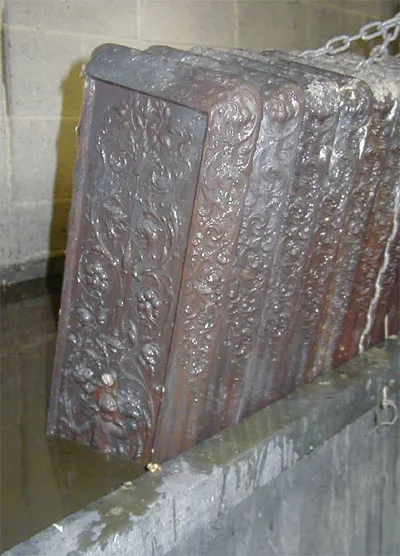
The honest limit is the same as on a facade: some damage is not economical to repair, and we will tell you that rather than take the job. For the full process, see our cast iron radiator restoration work in Mount Vernon.
Our earlier piece makes the case for restoring antique radiators in detail.
What Happens If You Restore Without Fixing the Cause
This is the honest caveat. Some failures come back if the underlying condition is left alone, however good the refinishing is.
Water getting in. Joints between castings were originally caulked to keep water out. Brief 27 calls replacing deteriorated caulking essential, because water inside a hollow casting rusts it from the inside out and can freeze and crack it.
Incompatible metals. Brief 27 notes that cast iron will be attacked and corroded when it sits against more noble metals such as lead or copper. A copper patch on an iron element can start a new problem.
Bad prior repairs. Concrete poured into balusters and newel posts is a common one. Brief 27 explains that concrete shrinks as it cures, traps water against the iron, and its alkaline nature accelerates corrosion. Those elements have to come apart.
Coatings chosen casually. Bare iron rusts again quickly if it is not protected properly. The primer and top coat are what make a restoration last.
A good survey catches most of this before any work starts. If you are planning a larger project, our guide to how a landmark restoration actually runs covers where the survey fits.
Common Questions About Cast Iron Restoration
These are the questions owners, architects, and property managers ask us when they are weighing a cast iron repair against a replacement.
Can cracked cast iron be repaired?
Often, yes. A clean crack in a sound casting is very repairable, and some pieces are best brazed while others need a section fabricated and let in. Superficial cracks can be filled. What rules a piece out is widespread pitting, a failed earlier repair, or a break through a section too thin to hold.
Is it cheaper to replace cast iron than to restore it?
Sometimes, for a small plain section that is cheaper to recast than to splice. For ornamental work it is rarely cheaper once you count new patterns, casting, fitting, finishing, and removal. On a designated building, replacement also calls for documented proof that repair will not work.
Can historic cast iron be replaced with aluminum or fiberglass?
It depends on the building and the element. On NYC individual landmarks, the Commission’s rules do not allow substitute materials for cast iron. Elsewhere, they may be permitted in limited cases, but aluminum touching cast iron can cause galvanic corrosion, and epoxy replicas cannot replace structural iron.
Is cast iron radiator restoration worth it?
For most radiators with sound castings, yes. Stripping, repair, and refinishing bring back detail that paint has buried, and faults like leaking joints or cracked sections are often repairable. Some damage is not economical to repair, and a good shop will say so before taking the job.
How can I tell if my cast iron is too far gone?
You usually cannot tell from a photo. Heavy rust and flaking paint can hide sound metal. The warning signs are iron that crumbles when scraped with a knife, deep pitting across the whole piece, and old repairs that have failed. A close inspection settles it.
Have cast iron you are not sure about?
Send us photos and a note on what you are seeing: rust, a crack, or decades of paint. We will tell you what is worth restoring and what is not, working on site and in our Mount Vernon shop across NYC and the tri-state area.
Where your radiators are matters to how this works in practice. We restore cast iron across Manhattan, the Bronx, Brooklyn, Queens and Westchester, and beyond New York in Greenwich and Stamford in Connecticut, and Jersey City, Hoboken and Montclair in New Jersey.