
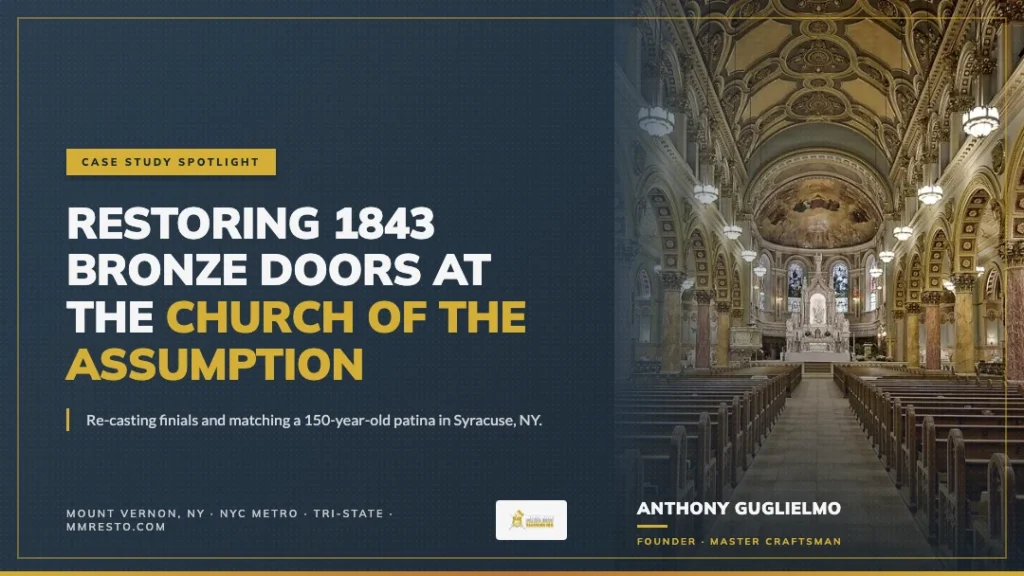
Restoring 1843 Bronze Doors at the Church of the Assumption
In August 2014, my team at Metal Man Restoration was hired to restore the main and side entranceways at the Franciscan Church of the Assumption in Syracuse, NY. Erected in 1843, the church’s bronze doors had never been restored in more than a century and a half of daily use. Here is how we brought them back to the tone the parish first knew.
The short version
- The project: the main and side entranceways at the Franciscan Church of the Assumption in Syracuse, NY, erected in 1843.
- The bronze doors had never been restored in more than 150 years of daily use.
- Condition: buried under many layers of oxidation, failed clear coating, dirt, and grime, with several small finials missing.
- We combined on-site work with detailed shop restoration. Door handles, lighting fixtures, and moldings came to our facility; the doors were restored in place.
- We cast replacements for the missing finials, then refinished the bronze and re-applied an oxidized patina to match its original tone.
- The month-long project returned the entranceways to the condition the parish first knew.
Some bronze has been waiting a long time for attention. Doors erected in 1843 and never restored have absorbed more than a century and a half of weather, handling, and well-meaning coatings. The metal underneath is almost always worth saving. The job is to clear away everything that has built up and bring back the tone the doors had when the church first opened.
What We Restored
The assignment covered the main and side entranceways, the bronze doors along with their handles, lighting fixtures, and moldings. For a parish that has used these doors daily since 1843, the entrance is more than hardware. It is the face of the church, and it had never had a proper restoration.
The Condition: 150 Years of Buildup
The bronze doors were in very poor condition, buried under many layers of oxidation, failed clear coating, dirt, and grime. Decades of weathering had also claimed structural pieces. Several small finials were missing entirely and had to be re-cast before the doors could be refinished. None of this is unusual for bronze that has gone unrestored for this long.
How We Restored the Entranceways
The project ran over a month and combined on-site work with detailed shop restoration. The removable elements, the door handles, lighting fixtures, and moldings, came to our facility where we could work on them under controlled conditions. The doors themselves were too central to remove, so we restored them in place.
After stripping the old coatings and grime, we cast replacements for the missing finials so the doors were whole again. Then we refinished the bronze and re-applied an oxidized patina to match its original tone. Matching the original is the part that takes judgment. The goal is a finish that looks like it always belonged, not a fresh coat that announces itself.
Why Matching the Original Patina Matters
On a building this old, the patina is part of the history. Re-applying an oxidized finish that matches the original tone keeps the doors true to the church rather than turning them into something new. A patina is developed into the bronze chemically, so it reads as authentic and ages gracefully, which is exactly what a 19th-century entrance calls for.
What This Means for Churches and Historic Institutions
If your church or institution has original bronze doors that have never been restored, the Assumption project is a useful model. Even after 150 years, the bronze is usually sound, missing finials can be re-cast, and the original patina can be matched. Restoration preserves the entrance the congregation knows rather than replacing it with something that does not belong. For the broader approach, see our architectural metal maintenance guide for property managers.
Common Questions About Restoring Historic Bronze Church Doors
These are the questions parishes and historic institutions ask us most about restoring original bronze entrances.
Can bronze doors that were never restored be saved?
Almost always. The Assumption doors had not been restored in over 150 years and were buried under oxidation and failed coatings, yet the bronze underneath was sound. Stripping the buildup, re-casting missing pieces, and refinishing brought them back. Age alone rarely puts bronze beyond saving.
Can missing finials be replaced?
Yes, by casting new ones. Several small finials were missing from the Assumption doors, and we cast replacements before refinishing. Casting to match keeps the doors complete and consistent, rather than leaving gaps or substituting parts that do not fit the original design.
Do the doors have to be removed?
Not always. At the Assumption, the doors were restored in place while the removable elements, handles, lighting fixtures, and moldings, came to our shop. Splitting the work that way keeps a church’s main entrance usable and still lets the detailed pieces get controlled shop attention.
Will the restored doors match the original look?
That is the goal. We re-applied an oxidized patina matched to the doors’ original tone, so the finish looks like it always belonged. A matched patina respects the building’s age, where a bright or mismatched finish would look wrong on a 19th-century entrance.
How do I start a church door restoration?
Send us photos of the doors and entrance, the building location, and a note on what you are seeing, oxidation, failed coatings, or missing pieces. We will tell you honestly if they are candidates for restoration and what the work would involve. You can reach us through our contact page.
Related guides in this series:
- The 1851 bronze sanctuary doors at St. Ignatius Loyola: refinished on site in New York City.
- Three bronze entrances at the Greek Orthodox Cathedral of St. Paul: entrances and light fixtures restored as a set.
- The bronze gates at the Alexander Hamilton U.S. Custom House: 1902 exterior gates, including re-cast missing pieces.
Have historic bronze doors or an entrance that needs restoring?
We restore bronze doors, hardware, and ornamental metal for churches, institutions, and historic buildings across the New York metro and the tri-state area.
More from our shop: see the full Church of the Assumption case study, our guide to architectural metal restoration for building owners and architects, and our spotlight on the award-winning bronze restoration at Newark City Hall.